

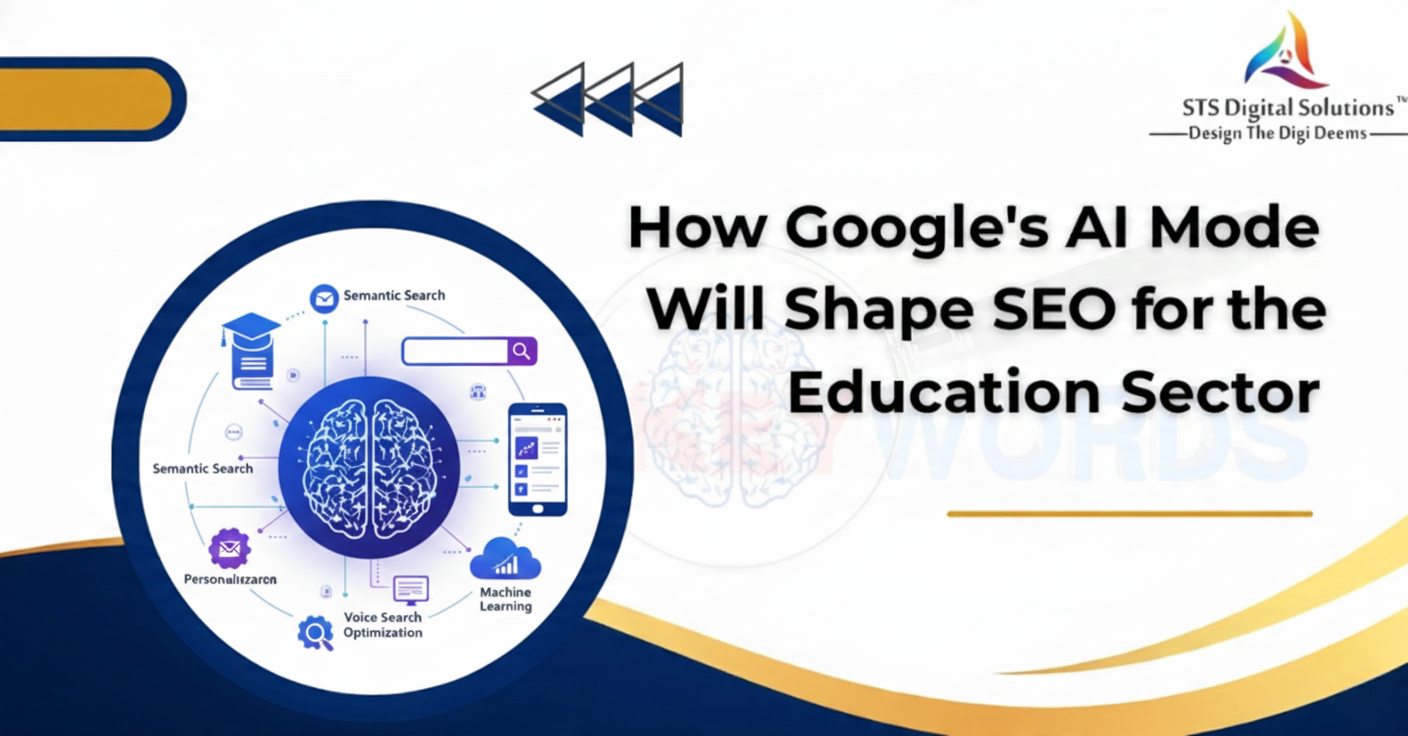
How Google’s AI Mode Will Reshape SEO for the Education Sector
The AI Mode developed by Google is one of the most significant transformations in the search result generation, assessment, and presentation process. Google now pays close attention to user intent, context, and content quality, utilizing artificial intelligence as opposed to relying solely on keywords and backlinks. This transformation is highly influential on the education industry, where students, parents, and professionals seek information that is reliable, detailed, and trustworthy.
In the case of educational establishments, edtech platforms, coaching centers, and providers of online courses, conventional SEO strategies are inadequate anymore. The AI Mode at Google values experience-based, authoritative, and intent-oriented content, and how education brands need to work to be seen in 2026 and beyond, and how education companies need to be ranked and grow digitally.
Key Ways Google’s AI Mode Is Reshaping SEO for the Education Sector
The most significant transformations, proposed by the AI Mode of Google, and the way in which the education-related websites are forced to change to stay competitive, are presented below.
1. Search Intent Will Matter More Than Keywords
The AI Mode of Google has been more focused on the reason why a user is searching as opposed to what the user is typing. Search queries in the education sector are usually about learning, career planning, or academic decision-making.
Educational websites should keep the content in line with various types of intent so as to remain relevant.
Strategic Intent-Centered will Involve:
- Developing informational, navigational, and transactional intent material.
- Giving straightforward answers to student questions.
- Not stuffing keywords and addressing topic depth.
- Organizing content to address actual learning problems.
2. Authority and Expertise Will Define Rankings
Google picks up educational content using AI Mode, which judges the credibility of the content more profoundly. It is more likely that institutions and platforms that prove their level of expertise, experience, and trustworthiness will get a higher ranking.
It is particularly important in the case of education, where accuracy and authority are important.
Strategies to Enhance Authority Indications are
- Posting articles authored or edited by their professional experts.
- Emphasizing the faculty qualifications and institutional experience.
- Integrating fact-based knowledge and studies.
- Having coherent and accurate information on different pages.
3. Long-Form, In-Depth Content Will Outperform Short Posts
Search with AI prefers in-depth resources that cover a subject. Brief, shallow articles are unable to compete with the deep-seated education guides.
The brands of education have to pay attention to the quality rather than the quantity.
The Content Depth Improvement Techniques are
- Designing pillar pages and course guide maps.
- Discussing issues in a wholesome manner rather than in bits.
- Follow-up questions are to be answered on the same page.
- Revising old information regularly to be relevant.
4. Conversational Queries and Natural Language Will Rise
Google is more conversational and question-based in terms of search with the use of AI Mode. All students are turning to voice search and long-established queries to seek answers.
SEO education should be able to follow this natural language change.
The Optimization Methods are:
- Headings and subheadings that are in the form of questions.
- Communicating in a friendly, student-centered manner.
- Including frequently asked questions was in line with user queries.
- Voice and AI-generated answer optimization.
5. User Experience Will Directly Impact SEO Performance
AI Mode assesses the interaction of the users with learning sites. Rankings can be hurt by things like high bounce rates or low load times, which are indicators of poor UX.
A smooth learning process has become a fundamental SEO ingredient.
The UX-Oriented SEO Optimization Includes:
- Enhancing rapid page loading and mobility.
- Planning the clarity in navigation of courses and resources.
- Enhancing the readability of content.
- Creating less clutter and distraction.
6. Structured Data Will Help AI Understand Content Better
Formatted information is an important aspect that contributes to the correct interpretation of the educational information by AI used by Google. It allows the search engine to locate courses, reviews, frequently asked questions, and institutions in a better way.
Schools that adopt a schema enjoy better publicity.
The key structured Types of Data are:
- Programs and certifications course schema.
- FAQ model of student inquiries.
- Credibility review and rating schema.
- Institutional organizational structure.
7. AI-Generated Search Results Will Reduce Click-Through Rates
The AI Mode of Google tends to provide the summarized answers right on the search results page. This will decrease organic clicks, particularly on basic informational searches.
There should be an adjustment of educational websites in their content strategy.
To Remain Competitive, It Can Be Done By:
- Producing something that prompts more exploration.
- The provision of downloadable resources and tools.
- Offering some distinct knowledge of the definition.
- Concentrating on brand awareness and power.
8. Local and Regional SEO Will Become More Personalized
AI Mode applies location, preferences, and behavior to provide personalized results. Local SEO is even more crucial when it comes to schools and colleges, as well as coaching centers.
Strategies of Local SEO Optimization Entail:
- Designing geographic landing pages.
- Google Business Profiles: Optimization.
- Publication of the locally relevant contents.
- Promotion of student reviews and testimonials.
9. Multimedia Content Will Gain SEO Importance
AI Mode does not consider only a text format but also other content forms. Videos, infographics, and interactive learning material increase engagement and SEO.
Brands in the education field are forced to change content format.
Multimedia SEO improvements involve:
- Including an explainer video on course pages.
- The visuals are used to break down difficult issues.
- Providing video transcripts and captions.
- Search optimization of multimedia files.
10. Continuous Content Optimization Will Be Essential
SEO in the AI era is not static. The AI in Google is constantly learning and evolving, and, therefore, continuous optimization is essential in the education websites.
The performance monitoring and refining institutions will remain on top.
The Continuous Optimization Practices Involve:
- The ability to keep the content updated with respect to the changes in search behavior.
- Analyzing performance using analytics.
- Enhancing the clarity and structure of the content regularly.
- Testing headlines, formats, and CTAs.
Conclusion
The AI Mode of Google is also radically transforming the SEO of the education sector, leading to a focus on intent, authority, user experience, and depth of content. Schools and websites that stick with their old-fashioned methods of using keywords to generate new information run the risk of becoming unnoticed in a smarter search platform. Rather, the success now is pegged on providing credible, all-inclusive, and user-friendly learning materials.
Education brands will be able to stay visible and credible and grow in the long run by adapting SEO according to the principles of AI, including intent-driven content, structured data, high-quality UX, and constant optimization. Through professional digital assistance from STS Digital Solutions, learning institutions can be assured to be ready to embrace the AI Mode of Google and create a future-proofed approach to SEO that sees learners being provided with the correct information at the correct time.

Sahil Goyal
Founder & CEO – STS Digital Solutions
Sahil Goyal is an experienced digital marketing strategist and growth leader, who has assisted some of the most successful BFSI & Healthcare, Automotive, and E-Commerce brands to attain sustainable and quantifiable digital success. Being the Founder & CEO of STS Digital Solutions, he spearheads performance-oriented actions in SEO, Digital Marketing, Social Media Marketing, Performance Marketing, E-Commerce Marketing, which assist business to create substantial online presence and generate continuous growth in revenues.
He is a pragmatic and data-driven consultant that focuses on the development of the scalable digital strategies wherein technical SEO, high-quality content, paid advertising, and performance marketing are merged. He is of the opinion that marketing should be aligned with the obvious business objectives, such as more organic traffic, stronger social media brand awareness, paid campaigns that are more ROI-friendly, or more e-commerce brands conversions.
Maximize Your Online Impact - Contact Our Experts!