


How Performance Marketing Helps E-commerce Brands Scale Profitably
Despite all of this, there is a case where a company has a great product, an attractive website, and thousands of visitors a month, but is failing to be profitable.
And again, this is not an issue of having too little traffic. The reason here is the inability to know what kind of marketing activities bring the most profitable clients.
For example, a brand may invest in social media ads as these ads bring clicks. Or another company may decide to increase its budget for search ads as its sales are growing. However, in the end, after analyzing the metrics, the company may discover that one campaign brings clients that buy only once and never return, whereas the other campaign brings few orders, but these clients are worth much more.
Here performance marketing comes into play.
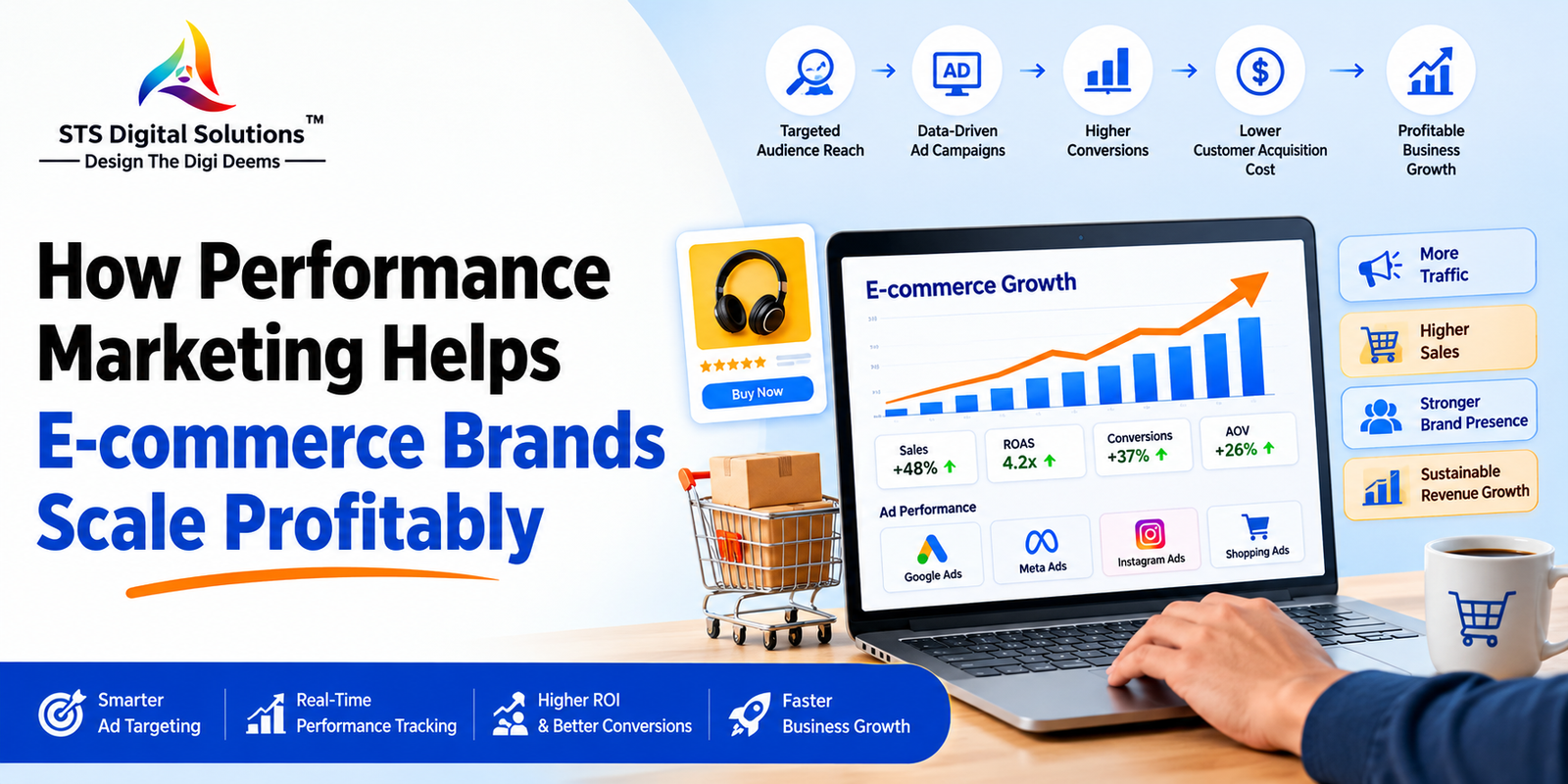
Rather than measuring the number of people who saw your ad, you can focus on the results, like lead generation, conversion, cost of customer acquisition, and sales. For an e-commerce brand in today's competitive environment, this change of focus can turn into a great asset.
Industry Insight
Online commerce has become an increasingly competitive field where the acquisition of a customer’s attention comes at a high cost, and the transition from one brand to another has become easy.
Customers have become capable of making comparisons and evaluating different prices, offers, and reviews in a few minutes’ time. The result of such a situation is that a company cannot be assured that an increase in its advertising budget will result in proportional growth in revenue.
It has become crucial in a scenario where digital marketing efforts are becoming more complex. Search advertising, social media campaigns, retargeting ads, shopping advertisements, influencer collaborations, email marketing, and other methods may all form parts of the consumer journey.
In such a situation, there exists a chance and a challenge too.
A company needs to know which advertising methods attract suitable customers, which messages persuade customers to make purchases, and at what stage customers discontinue their journey.
A solution to this challenge lies in the concept of modern performance marketing.
It allows one to integrate all marketing efforts with business metrics and results.
Expert Commentary
The most important principle in performance-driven e-commerce is not simply to reduce advertising costs. It is to improve the relationship between marketing investment and business value.
A campaign with a low cost per click may look efficient, but inexpensive traffic has little value if visitors rarely purchase.
Similarly, a campaign with a higher acquisition cost may be commercially attractive if it brings customers who purchase repeatedly and have a strong lifetime value.
Start With Profitability, Not Vanity Metrics
Clicks, impressions, and follower counts can provide useful information, but they should not become the primary definition of success.
For e-commerce businesses, stronger indicators include conversion rate, customer acquisition cost, average order value, repeat purchase rate, and revenue generated relative to advertising expenditure.
These metrics provide a clearer picture of whether marketing is contributing to business growth.
Understand the Entire Customer Journey
A customer rarely moves from seeing one advertisement directly to completing a purchase.
They may discover the brand through social media, search for reviews, visit the website, leave without purchasing, receive a remarketing message, and return several days later.
If a business evaluates each interaction in isolation, it can misunderstand what is actually driving conversions.
Effective measurement therefore requires a broader view of the customer journey.
Improve the Offer Alongside the Advertising
Advertising cannot permanently compensate for a weak product offer.
If customers arrive at a product page and find unclear information, poor imagery, unexpected shipping costs, or an inconvenient checkout process, increasing advertising spend may simply increase the number of people experiencing the same friction.
Performance marketing works best when advertising, landing pages, pricing, product presentation, and conversion experience are considered together.
Proof & Real-World Perspective
Consider an online fashion retailer running two campaigns.
Campaign A generates 1,000 visitors and 50 purchases. Campaign B generates 600 visitors and 45 purchases.
At first glance, Campaign A appears more successful because it brings significantly more traffic and slightly more sales.
But suppose customers acquired through Campaign B purchase again more frequently and have a higher average order value. The apparently smaller campaign may actually create more long-term business value.
This illustrates why e-commerce performance cannot be judged through traffic volume alone.
Another example is a brand experiencing high cart abandonment.
The marketing team might assume that more remarketing advertisements are needed. But analysis could reveal that customers are abandoning carts because shipping charges appear unexpectedly during checkout.
In this situation, improving checkout transparency may produce a stronger commercial result than simply increasing advertising frequency.
The lesson is straightforward: performance data should guide business decisions, not merely advertising decisions.
Analysis
A well-structured performance marketing approach can provide several advantages for e-commerce brands.
More Accountable Marketing Investment
Because campaigns are connected to measurable outcomes, businesses can identify where money is producing meaningful results and where it is being wasted.
This does not mean every campaign must generate immediate purchases. Awareness and consideration activities can also have value. The important point is understanding their role within the broader customer journey.
Better Budget Allocation
Performance data can help businesses decide where additional investment is justified.
If one audience consistently converts at a stronger rate while another produces expensive, low-value customers, marketing budgets can be adjusted accordingly.
However, brands should avoid making decisions based on short-term fluctuations. Seasonality, promotions, product launches, and changes in demand can affect campaign performance.
Continuous Optimisation
Unlike traditional campaigns that may run unchanged for long periods, digital campaigns can be tested and improved continuously.
Creative variations, audiences, landing pages, offers and calls to action can be evaluated against meaningful performance indicators.
The objective is not endless experimentation. It is systematic learning.
Stronger Customer Acquisition
A mature strategy looks beyond acquiring the cheapest possible customer.
The more useful question is whether the customer is likely to remain valuable.
This brings customer lifetime value into the conversation. A business that acquires loyal customers at a reasonable cost may be in a stronger position than one that generates inexpensive but one-time transactions.
Common Mistakes Can Reduce Profitability
One of the biggest mistakes is scaling campaigns before understanding unit economics.
If an e-commerce brand loses money on every transaction, increasing sales volume does not solve the underlying problem.
Other common issues include relying on a single advertising platform, ignoring organic search, using weak product pages, failing to test creative variations, and making decisions based on incomplete attribution data.
The solution is not necessarily more marketing. It is better-connected marketing and business analysis.
Recommendations
E-commerce brands planning to strengthen their performance marketing efforts should build their strategy around commercial fundamentals.
Define the Numbers That Matter
Establish acceptable customer acquisition costs, target conversion rates, average order values, and profitability thresholds before aggressively increasing advertising budgets.
These benchmarks make campaign decisions more objective.
Segment Customers and Audiences
Different customers can have very different levels of value.
Analyse new versus returning customers, product categories, geographic markets, and audience groups where relevant. This can reveal opportunities that broad campaign averages hide.
Strengthen Product and Landing Pages
Advertising should take users to pages that clearly communicate the product's value.
Strong product photography, useful descriptions, transparent pricing, reviews, delivery information, and a frictionless checkout process can influence conversion as much as the advertisement itself.
Test Before Scaling
Do not dramatically increase spending simply because a campaign performs well for a short period.
Test creative concepts, audiences, offers, and landing experiences first. Once performance is sufficiently consistent, scale gradually while monitoring profitability.
Use Multiple Channels Strategically
Search, social media, SEO, email, and remarketing can serve different stages of the customer journey.
A balanced e-commerce marketing strategy reduces dependence on one traffic source and creates more opportunities to reach customers at relevant moments.
Measure Long-Term Value
Track what happens after the first purchase.
Repeat orders, customer retention, and lifetime value can reveal whether acquisition campaigns are building a sustainable customer base or simply producing temporary sales spikes.
Closing Thoughts
For e-commerce brands, growth becomes more valuable when it is measurable and profitable.
Performance marketing provides a framework for connecting marketing investment with tangible business outcomes, but its real strength comes from the decisions made around the data. Businesses that understand their customers, monitor unit economics, improve conversion experiences, and continuously test their strategies are better positioned to scale without treating advertising spend as an endless growth lever.
The objective should not be to spend more simply to generate more orders. It should be to build a marketing system in which every major investment has a clear purpose and measurable commercial contribution.
STS Digital Solutions can help e-commerce businesses develop data-driven digital strategies across paid advertising, SEO, social media and other digital channels. With the right combination of measurement, optimisation and customer understanding, performance marketing can become more than an advertising tactic—it can become a disciplined growth engine for the business.

Sahil Goyal
Founder & CEO – STS Digital Solutions
Sahil Goyal is an experienced digital marketing strategist and growth leader, who has assisted some of the most successful BFSI & Healthcare, Automotive, and E-Commerce brands to attain sustainable and quantifiable digital success. Being the Founder & CEO of STS Digital Solutions, he spearheads performance-oriented actions in SEO, Digital Marketing, Social Media Marketing, Performance Marketing, E-Commerce Marketing, which assist business to create substantial online presence and generate continuous growth in revenues.
He is a pragmatic and data-driven consultant that focuses on the development of the scalable digital strategies wherein technical SEO, high-quality content, paid advertising, and performance marketing are merged. He is of the opinion that marketing should be aligned with the obvious business objectives, such as more organic traffic, stronger social media brand awareness, paid campaigns that are more ROI-friendly, or more e-commerce brands conversions.
Maximize Your Online Impact - Contact Our Experts!