

How Real Estate Companies Generate Qualified Leads Using AEO & GEO In 2026
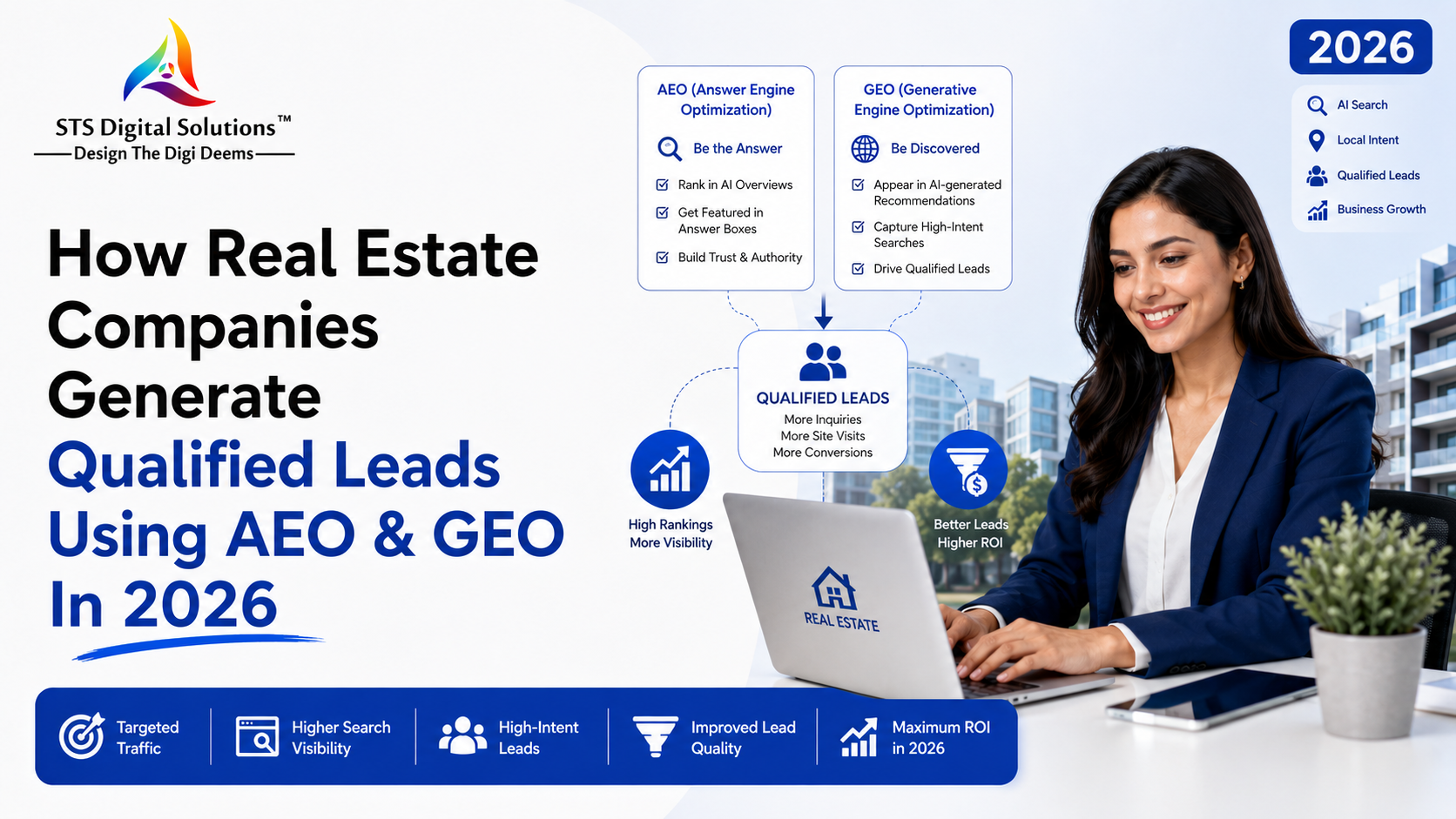
In 2026, real estate businesses are producing more leads that qualify because of AEO and GEO For Real Estate campaigns, along with the regular SEO. Real estate businesses are no longer ranking in search engines using Google alone, as these real estate businesses are focusing on producing content optimized for appearing in AI search algorithms, voice search queries, answer engines, and generative search engines. Through producing content that builds topical authority and leveraging structured data for the properties’ frequently asked questions, real estate companies are attracting customers, investors, and sellers interested in finding answers regarding properties.
Key Takeaways
- AEO and GEO for Real Estate help businesses capture leads from modern search experiences.
- AI-driven search platforms are changing how property buyers discover real estate companies.
- Structured content and answer-focused pages improve visibility and trust.
- Voice search and conversational search are becoming major lead generation channels.
- Real estate companies using AEO and GEO often experience higher lead quality.
- Authority-driven content helps attract serious buyers and investors.
- Businesses that adapt early gain a significant competitive advantage.
What You Need to Know
There exists stiff competition within the real estate sector. Traditional ways of lead generation, such as utilizing property listing platforms and placing advertisements, still work effectively despite the changing demands of buyers.
It is the case that at present, many people carry out extensive searches before contacting a real estate agent. This entails getting details on locations, costs, investment options, amenities, and market trends through new-age search engines.
Here comes the importance of AEO and GEO for Real Estate
As the name suggests, Answer Engine Optimization concentrates on enabling search engines to offer users direct answers to their queries. GEO assists in making businesses noticeable on AI-enabled search engines that make suggestions and summarize results.
Important Factors
Real estate businesses must focus on several critical elements when implementing AEO and GEO for Real Estate strategies.
Create Answer-Focused Content
Potential buyers often search for:
- Best residential projects in a city
- Property investment opportunities
- Commercial real estate options
- Home loan-related questions
- Local market trends
Content should directly answer these queries.
Build Topical Authority
Real estate websites should cover:
- Property buying guides
- Investment advice
- Local area insights
- Property comparison content
- Market reports
Comprehensive content improves authority and trust.
Implement Structured Data
Structured data helps search engines understand:
- Property listings
- Locations
- Reviews
- FAQs
- Business information
This improves visibility across modern search experiences.
Optimize for Voice Search
Many users now search using conversational queries such as:
- Which area is best for investment?
- What are the top residential projects near me?
- Is now a good time to buy property?
Voice search optimization is becoming increasingly important.
Benefits / Advantages
Real estate companies that invest in AEO and GEO for Real Estate gain several advantages over competitors.
-
Higher Quality Leads- Visitors arriving through answer-focused searches typically have stronger buying intent and are closer to making decisions.
-
Increased Search Visibility- Businesses appear in more search experiences beyond traditional search results.
-
Improved Brand Authority- Consistently providing accurate and helpful information positions the company as a trusted market expert.
-
Better Lead Conversion Rates- When users find answers before contacting a company, they often enter the sales process more informed and qualified.
-
Reduced Dependence on Paid Advertising - Strong organic visibility helps lower customer acquisition costs over time.
Why It Matters
The way people search for property information is changing dramatically.
Instead of simply searching "apartments for sale," users now ask detailed questions such as:
- Which location offers the best ROI?
- What is the average property price in a specific area?
- Which builder has the best reputation?
- Is this project suitable for investment?
Companies implementing AEO and GEO for Real Estate can position themselves directly within these conversations.
For example, a real estate developer that publishes comprehensive location guides, investment insights, project comparisons, and FAQ-driven content can attract highly targeted visitors before competitors even appear on the buyer's radar.
This creates stronger trust and increases lead generation opportunities.
Common Mistakes to Avoid
Many real estate companies struggle with modern search optimization because they make avoidable mistakes.
-
Ignoring User Questions- Content should answer real buyer concerns instead of focusing only on promotional messaging.
-
Relying Only on Property Listings- Listings alone rarely establish authority. Educational content is equally important.
-
Poor FAQ Optimization- Many websites fail to structure FAQs properly, reducing answer visibility opportunities.
-
Weak Local Content- Location-specific information is crucial for attracting qualified property buyers.
-
Neglecting Content Updates- Real estate markets change frequently. Outdated content can reduce trust and visibility.
Expert Insights
Industry experts increasingly recommend combining SEO, AEO, and GEO rather than treating them as separate strategies.
For real estate companies, the most effective approach includes:
- Building topic clusters around locations and property types.
- Publishing detailed buyer and investor guides.
- Creating answer-focused FAQ sections.
- Using structured data across property pages.
- Developing authority through consistent educational content.
- Optimizing for conversational search behavior.
- Monitoring emerging search trends regularly.
The most successful real estate brands in 2026 are not simply ranking for keywords—they are becoming trusted sources of information.
This is why AEO and GEO for Real Estate are rapidly becoming essential components of modern property marketing strategies.
Frequently Asked Questions
Q1. What is AEO in real estate marketing?
Answer Engine Optimization (AEO) helps real estate businesses appear in answer-focused search results by providing direct and structured responses to user queries.
Q2. How does GEO help real estate companies generate leads?
Generative Engine Optimization improves visibility in AI-powered search experiences, helping businesses reach users who are actively seeking property-related information.
Q3. Is AEO better than traditional SEO?
AEO is not a replacement for SEO. The best results come from combining SEO, AEO, and GEO into a unified strategy.
Q4. Can small real estate agencies benefit from AEO and GEO?
Yes. Local agencies can significantly improve visibility and lead quality by optimizing content for local property-related searches.
Q5. How long does it take to see results from AEO and GEO?
Most businesses begin seeing measurable improvements within three to six months, depending on competition and content quality.
Q6. What type of content works best for real estate AEO?
FAQs, property guides, investment insights, location pages, market updates, and comparison articles perform particularly well.
Final Takeaway
The future of real estate marketing is shifting toward answer-focused and AI-driven search experiences. Companies that implement AEO and GEO for Real Estate strategies today are better positioned to attract qualified buyers, investors, and property seekers tomorrow. By focusing on authority, structured content, user intent, and search visibility, real estate businesses can generate higher-quality leads while reducing dependence on traditional advertising channels. At STS Digital Solutions, we help real estate companies leverage modern SEO, AEO, and GEO strategies to improve visibility, build trust, and generate sustainable business growth in 2026 and beyond.

Sahil Goyal
Founder & CEO – STS Digital Solutions
Sahil Goyal is an experienced digital marketing strategist and growth leader, who has assisted some of the most successful BFSI & Healthcare, Automotive, and E-Commerce brands to attain sustainable and quantifiable digital success. Being the Founder & CEO of STS Digital Solutions, he spearheads performance-oriented actions in SEO, Digital Marketing, Social Media Marketing, Performance Marketing, E-Commerce Marketing, which assist business to create substantial online presence and generate continuous growth in revenues.
He is a pragmatic and data-driven consultant that focuses on the development of the scalable digital strategies wherein technical SEO, high-quality content, paid advertising, and performance marketing are merged. He is of the opinion that marketing should be aligned with the obvious business objectives, such as more organic traffic, stronger social media brand awareness, paid campaigns that are more ROI-friendly, or more e-commerce brands conversions.
Maximize Your Online Impact - Contact Our Experts!