

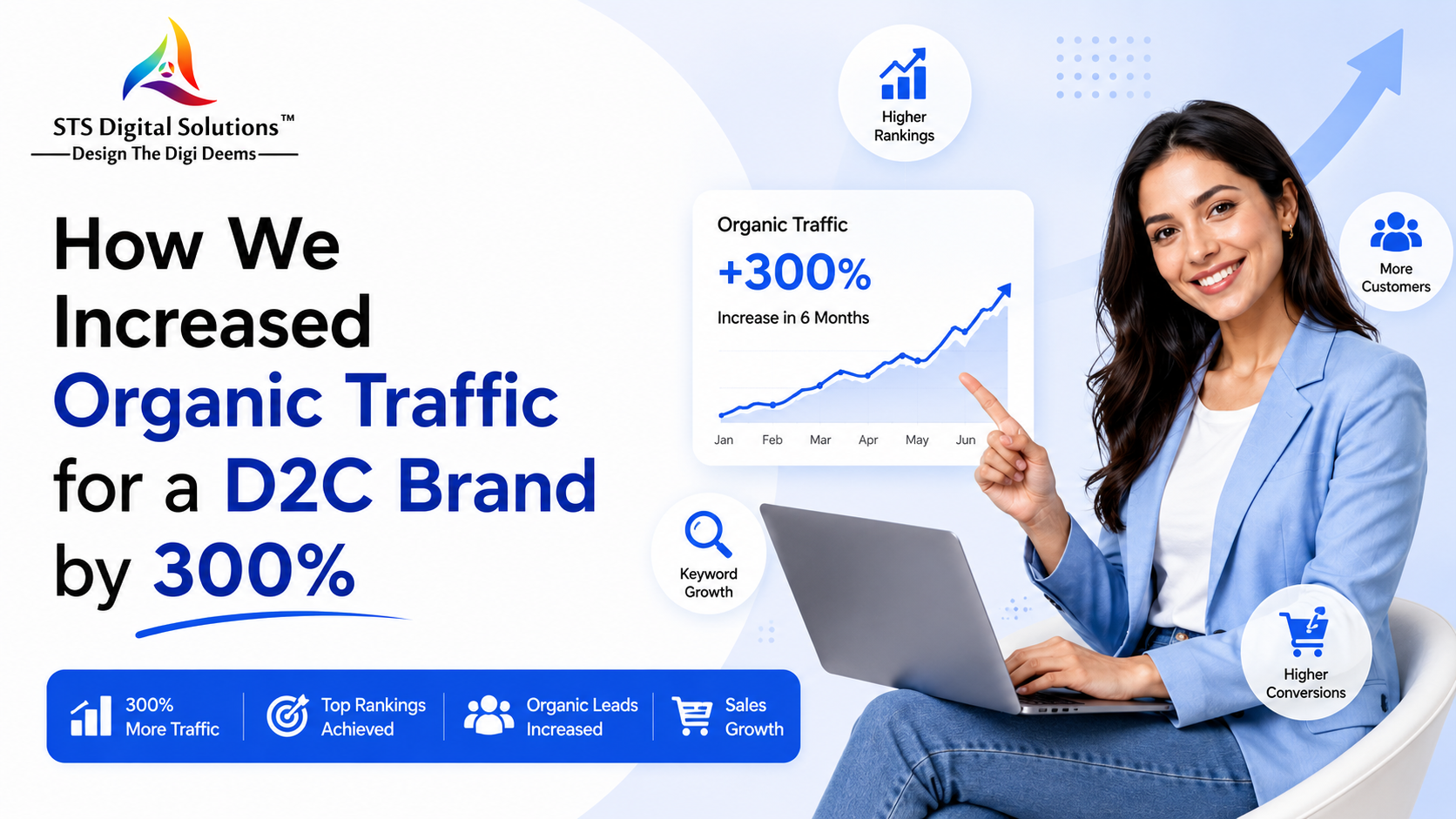
How We Increased Organic Traffic for a D2C Brand by 300%?
However, in the competitive realm of the D2C industry, depending solely on paid advertising becomes too costly. High customer acquisition costs, unpredictable ROAS, and fierce competition mean that brands struggle to generate sustainable growth using just advertising.
This is something that one of our clients encountered. In spite of the quality of their products and the fact that they run campaigns, the client had very little organic reach and was almost completely reliant on paid means to generate income.
Our company played an instrumental role in helping our clients develop a comprehensive long-term SEO strategy, which resulted in improved organic visibility. After nine months since the implementation of our strategy, we were able to get our client a 300% growth in organic traffic.
About the Brand
Our client was a rising D2C lifestyle brand that directly sold its goods via the eCommerce platform. Being a company operating within a highly competitive niche market segment, it had managed to establish some traction by utilizing Meta Ads and working together with influencers. Yet, all the sales made came from paid traffic sources, making this business operation unsustainable.
The need for establishing a source of traffic generation that would yield successful results without increasing their advertising spending became apparent to the brand. The main focus of the company was on optimizing organic visibility and bringing qualified traffic to the website from Google.
The Problem
At the start of this project, there was not enough organic traffic coming to the website, even though it had plenty of products and categories.
The company faced several challenges. Product pages lacked proper optimization, blog content was almost non-existent, and many important keywords were not ranking. The technical problems also impacted the site’s ability to be effectively indexed by search engines.
With the intensification of competition, it became apparent that it was not sufficient to rely only on paid acquisition to grow.
Initial SEO Audit Findings
Our first step was conducting a comprehensive SEO audit to identify gaps and opportunities. The audit revealed several issues affecting search visibility and organic performance.
The website had multiple technical SEO problems, including slow page speed, duplicate metadata, and crawlability issues. Product descriptions were generic and lacked keyword optimization. Internal linking was weak, making it difficult for search engines to understand the relationship between pages.
We also discovered that the brand had no structured content strategy. While competitors were publishing educational content and targeting informational keywords, the client was missing opportunities to attract customers during the research phase of the buying journey.
Our SEO Strategy
Instead of focusing on quick wins, we created a long-term SEO roadmap designed to improve authority, rankings, and revenue. The strategy combined technical SEO, content marketing, product page optimization, and keyword targeting.
Our objective was not simply to increase traffic. We wanted to attract users who were genuinely interested in purchasing products. This meant focusing on search intent, creating valuable content, and improving every stage of the customer journey.
The strategy was divided into multiple phases, each addressing a specific aspect of organic growth.
Phase 1: Fixing Technical SEO Issues
Before investing in content and keyword optimization, we resolved technical barriers that were limiting performance. Search engines need to crawl and index websites efficiently before rankings can improve.
Our team improved page speed, optimized Core Web Vitals, fixed crawl errors, corrected duplicate content issues, and enhanced mobile responsiveness. We also optimized site architecture to make navigation easier for both users and search engines.
These improvements created a stronger foundation for future SEO efforts and improved the overall user experience.
Phase 2: Building a Content Strategy
Once the technical foundation was established, we developed a content marketing strategy focused on search intent and customer needs.
Extensive keyword research helped us identify topics that potential customers were actively searching for. Instead of targeting only product-related terms, we created content around buying guides, product comparisons, industry trends, and frequently asked questions.
This approach allowed the brand to attract visitors at different stages of the buying journey. Over time, the website began building topical authority within its niche, helping both content pages and product pages rank more effectively.
Phase 3: Optimizing Product and Collection Pages
Many D2C brands underestimate the importance of product page SEO. In this case, product pages represented one of the biggest growth opportunities.
We rewrote product descriptions to make them unique, informative, and keyword-focused. Category pages were optimized with better content, metadata, and internal linking. Product titles, image alt tags, and structured data were also improved.
These enhancements made the pages more relevant to search engines while providing a better experience for customers. As rankings improved, product pages began attracting high-intent visitors who were ready to purchase.
Phase 4: Building Authority Through Content
Content became the engine that drove organic growth. We consistently published educational articles designed to answer customer questions and establish the brand as an authority in its industry.
Each article was strategically linked to relevant categories and product pages, creating a strong internal linking structure. This not only improved user navigation but also distributed authority throughout the website.
Over time, Google recognized the website as a valuable resource within its niche, resulting in stronger rankings across multiple keyword categories.
The Results After 9 Months
The impact of the SEO campaign became increasingly visible over time. Organic traffic grew steadily, keyword rankings improved, and revenue from organic channels increased significantly.
| Metric | Before SEO | After SEO |
|---|---|---|
| Organic Traffic | 4,500/month | 18,200/month |
| Ranking Keywords | 72 | 450+ |
| First-Page Keywords | 15 | 180+ |
| Monthly Revenue | ₹7 Lakhs | ₹28 Lakhs |
| Customer Acquisition Cost | ₹1,380 | ₹820 |
| ROAS | 3.1X | 6.6X |
These results demonstrated the power of a well-executed SEO strategy. The brand was no longer dependent solely on advertising and had established a sustainable source of organic growth.
Key Learnings From This Project
One of the biggest lessons from this campaign was that SEO is not about ranking a few keywords. It is about building a complete ecosystem that supports long-term growth.
We also learned that content and product pages must work together. Educational content attracts visitors, while optimized product pages convert them into customers. Ignoring either component limits results.
Another important takeaway was the value of patience. SEO does not deliver overnight success, but when executed correctly, the long-term benefits far outweigh the investment.
Finally, user experience played a critical role. Faster pages, better navigation, and improved mobile performance contributed significantly to both rankings and conversions.
How This Applies to Other D2C Brands
The strategies used in this project can be applied across multiple industries, including fashion, beauty, skincare, wellness, home décor, electronics, and lifestyle products.
Whether you are a startup or an established eCommerce brand, SEO can help reduce dependency on paid advertising while creating a sustainable source of traffic and revenue.
As a trusted D2C marketing agency, D2C performance agency, and D2C Branding Agency, STS Digital Solutions has helped businesses across Gurgaon, Faridabad, and NCR improve visibility, increase conversions, and scale profitably through integrated digital marketing strategies.
Conclusion
This case study demonstrates that sustainable growth does not come from increasing ad budgets alone. By investing in technical SEO, content marketing, product page optimization, and authority building, D2C brands can create a powerful organic growth engine that continues delivering results month after month.
At STS Digital Solutions, we have helped D2C businesses achieve significant improvements in traffic, rankings, ROAS, and revenue. Our team combines SEO, content marketing, branding, and performance marketing to build growth strategies tailored to each business. If your brand is looking to reduce acquisition costs, improve visibility, and increase sales, now is the time to invest in long-term organic growth.

Sahil Goyal
Founder & CEO – STS Digital Solutions
Sahil Goyal is an experienced digital marketing strategist and growth leader, who has assisted some of the most successful BFSI & Healthcare, Automotive, and E-Commerce brands to attain sustainable and quantifiable digital success. Being the Founder & CEO of STS Digital Solutions, he spearheads performance-oriented actions in SEO, Digital Marketing, Social Media Marketing, Performance Marketing, E-Commerce Marketing, which assist business to create substantial online presence and generate continuous growth in revenues.
He is a pragmatic and data-driven consultant that focuses on the development of the scalable digital strategies wherein technical SEO, high-quality content, paid advertising, and performance marketing are merged. He is of the opinion that marketing should be aligned with the obvious business objectives, such as more organic traffic, stronger social media brand awareness, paid campaigns that are more ROI-friendly, or more e-commerce brands conversions.
Maximize Your Online Impact - Contact Our Experts!