

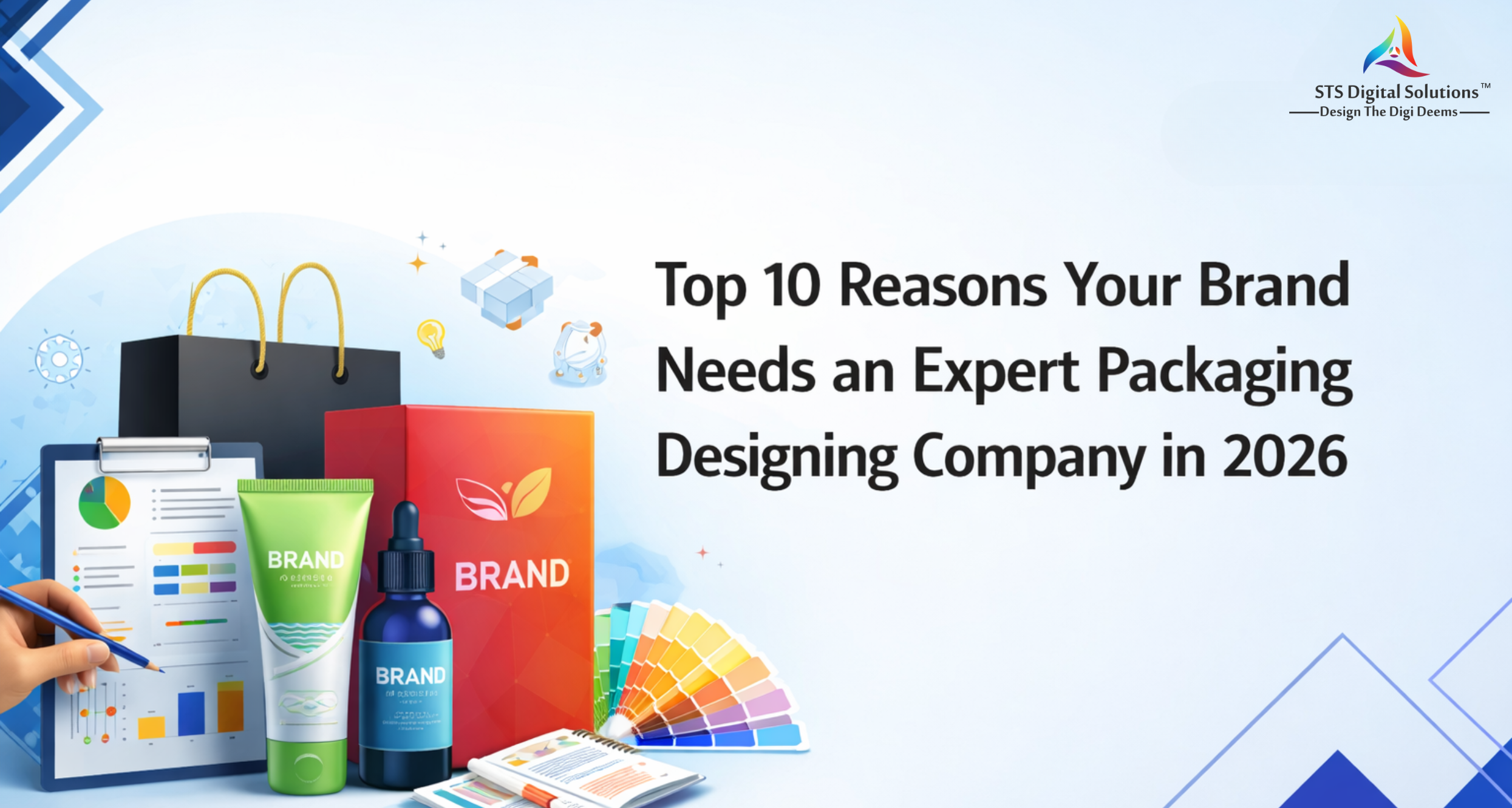
Top 10 Reasons Your Brand Needs an Expert Packaging Designing Company in 2026
The packaging environment has changed drastically. AI-prototyped designs to carbon-labeled products and digital product passports, 2026 requires more than ever before in your packaging. This is why joining a professional packaging designing firm is the only smartest brand investment you can make this year.
By 2026, your package will be required to perform better than ever, whether it is in three seconds or less on a shelf in the retail store or in a social media feed or at the doorstep of a customer. It should convey value, promise sustainability through validated facts, be a part of a digital ecosystem, and be an experience worth sharing. It requires a committed packaging designing company that understands design strategy, material science, AI tooling, and brand psychology as a single discipline.
Reasons Your Brand Should Have an Expert Packaging Designing Company
1. Carbon Labels and Anti-Greenwashing Laws are Re-writing the Rules of Packaging
Amongst the most notable changes in packaging in 2026 is the emergence of Carbon Labels printed information on packaging that shows the precise carbon footprint of a product throughout its lifecycle. Under pressure of escalating anti-greenwashing policies around the world, such as the SB 343 that is in California with a compliance deadline of October 2026 and the EU Packaging and Packaging Waste Regulation (PPWR), brands cannot continue to make unsubstantiated statements of eco-friendliness unless they have on-pack evidence.
This is where a professional packaging designing company is important. To make a design that includes carbon information, certification logos (FSC, PCR, How2Recycle PRO), and instructions on how to recycle needs specialized skills, you must understand where these elements belong, how to interrelate with the main brand imagery, and how to make compliance look like a brand feature and not a legal appendix. Brands that have this right earn retailers high shelf placement and customer confidence.
2. AI Powered Design and Rapid Prototyping Is Revolutionizing Speed to Market
AI has radically transformed the process of designing, testing, and refining packaging. By 2026, the best packaging designing company will use AI throughout the design process starting with generative concept development which generates hundreds of layout and colour variations in minutes, and machine learning models that can predict the behaviour of a design in a real retail shelf before a single unit is printed.
- Generative ideation
Hundreds of layout, colour and structure possibilities created within minutes providing designers with a rich creative springboard rather than a blank canvas.
- Shelf-performance prediction
ML models simulate the shelf context online showing the competition among the designs prior to the investment in production funds.
- Sentiment analysis
AI analyses millions of consumer reviews to figure out which particular design signals evoke positive emotions in your category.
- Variable data prototyping
Online printing services allow short run, personalized packaging at nearly offsetting costs and tested and improved prior to full implementation.
3. Digital Product Passports are Emerging as a Mandatory Standard Brand
A Digital Product Passport (DPP) is a digital identity built inside your package, which can be accessed by scanning a QR, NFC, or DataMatrix, that contains the complete lifecycle narrative of a product: what and where it was made of, its carbon footprint, how it was manufactured, what to recycle, authenticity certificates, and what to do after purchase.
- Authenticity verification - Luxury and pharma brands have turned to DPP to fight counterfeit and provide cryptographic evidence of authenticity.
- Circular recovery - Consumers scan to locate closest recycling or refill locations, which is a direct support of sustainability initiatives.
- After sales interactions - Recipes, tutorials, loyalty points and AR experiences activated inside the pack.
- Supply chain transparency - Farm to shelf traceability of food and drink brands that develop consumer confidence.
4. Universal and Approachable Packaging Is Scooping World Awards and Customer Hearts
Inclusive packaging was highlighted in the 2025 Dieline Awards and Pentawards as one of the defining design trends of this period and is where it will become an actual market differentiator. Accessible packaging design includes ergonomic grips that allow users with low hand strength to open or hyper-legible typography like the Atkinson Hyperlegible typeface, which is recommended by the American Braille Institute and Braille, magnetic fasteners, which need little force to open, oversized tear strips, and high-contrast colour schemes for people with low vision.
Accessibility audits are a routine feature of the packaging designing process and expert packaging designing company incorporate usability into all of the structural and visual decisions of the design process not as an afterthought but as an integral feature.
- Multi-Sensory Unboxing Experiences Are Engineered Not Accidental
The most iconic packaging in 2026 is created as a multi-sensory experience, rather than a one-time visual perception. Even before the product is even perceived, the pleasing click of a magnetic closure is an indicator of quality. A massive paperboard conveys value when you pick it up. Some brands are also incorporating signature scents in their packaging materials, which form an immediate brand recognition and emotional memory recall mechanisms that work below conscious perception.
- Touch
Soft-touch finishes, embossing, debossing and textured substrates, which convey quality via feel alone.
- Sound
Magnetic closure clicks, tissue paper whispers, rigid box lifts all designed to provide the gratifying unbox.
- Sight
Matte-gloss contrast, foil accents, spot UV reveals and inner-lid printing all to reward the reveal moment.
- Scent
Aromatic inks and injected materials that make an olfactory brand signature the latest innovation in high-end unboxing.
6. Circular Packaging Design and Mono-Material Have become a Regulatory Requirement
Mono-material packaging developed using one polymer family that is there are no multi-layer laminates that form the basis of traditional packaging, and in consequence, making it virtually unrecyclable has become the structural change defining sustainable packaging in 2026.
7. Smart Connected Packaging transforms all the boxes into animated brand platforms
The widespread of AI and IoT is transforming the consumer-brand relationship wherein each package is a dynamic digital object, known within the industry as Packaging 4.0. AR-enabled bottles unlocking recipes and virtual worlds on scan, limited-edition packs unlocking AI co-creation experiences on scan, IoT sensors in cold-chain packaging tracking temperature and humidity in real time.
Well-designed connected packaging has a scan rate of between 3-8 percent among highly engaged users. The level of engagement increases by an additional 10-15 percent when the scan provides something truly helpful, such as care instructions, a place to refill finder, time-limited discount, or an interactive brand narrative. The strategic benefit is compounding: with every scan, a direct consumer data point, a post-purchase touchpoint, and an opportunity at generating loyalty is created.
8. Human-Touch Aesthetics Are the Most Powerful Counter-Trend to AI in 2026
With AI swamping the design scene with instantly created and algorithmically generated visuals, a strong opposite trend has arisen and is sweeping the world of packaging awards: the active embrace of human flaws. Hand drawings, imprecision in fonts, texturing, and hand made details that easily reveal a human hand are striking a chord with consumers who are becoming more and more exhausted by algorithmic content.
The most elegant form is called Heritage Etch that revives linework of an engraving style, old-archival graphics, classic themes and old typography re-energized with contemporary layout and a heavy-handed colour effect. The message which it conveys is specific and emotionally powerful: somebody crafted this with attention. That signal is remarkable in a world full of AI-created sameness. The brands that invest in the human-touch design of packaging in 2026 are creating brand equity that cannot be duplicated through template tools and AI generators.
9. Refillable and Reusable Packaging Has Transitioned to Expectation
Multi-purpose and refillable packaging is on the other side of the adoption curve in 2026 in that it is not an experimental luxury or a sustainability niche. Other large CPG brands such as Unilever and Nestle have also joined forces with Loop and its circular shopping platform to implement reusable, durable packaging of daily necessities. The market has already spoken: the packaging that could be retained, repurposed, or reused, is now an expectation among consumers in various categories.
Integration Incorporation of refill system that structural engineering that renders the refill action brand-strengthening, satisfying, and intuitive.
Multi-purpose transformation - The packaging can be turned into a storage, display or useful household item extending the brand presence forever.
Circular communication — the design language on the packaging that reveals the intent to reuse and makes it desirable and shareable on social media.
10. D2C & E-Commerce Packaging Requires an Entirely New Expertise
The proliferation of Direct-to-Consumer brands and e-commerce has resulted in a completely new field of packaging discipline. E-commerce packages have to endure a rough transportation process that includes drops, compression, and moisture and provide a high-end brand experience as soon as it is received. It has to convey brand values without any retail context and transform a corrugated mailer into a brand statement. And it needs to be flawless in terms of product photography of digital store fronts, where the first brand contact a consumer has is often the thumb nail image.
Why Canva, AI Generators and Freelancers Cannot Substitute a Dedicated Packaging Designing Firm
As most template design tools, AI image generators, and global freelance marketplaces are now more accessible than ever, numerous emerging brands are tempted to save on the cost of packaging design. It is a logical appearing urge but one of the most costly errors that brand owners can make regularly and the bills are usually received when the printing is in progress, not when the design is in progress.
Collaborating with a focused packaging designing company such as the STS Digital Solutions implies that your brand can have access to a single multi disciplinary unit of brand strategists, structural engineers, regulatory experts, artwork production managers, and pre-press technicians, working as a single team with proprietary processes that have been perfected on hundreds of successful projects.
Conclusion
The data of the 2026 packaging landscape speaks volumes: the winning brands in their categories are using packaging as strategic infrastructure, rather than cost to control. They are collaborating with professional packaging design firms who can see the big picture that not only AI-powered design and carbon labels, but also multi-sensory unboxing engineering and new material innovation.
Each of the trends influencing packaging in 2026 will require more expertise, rather than less. The regulatory environment is more intricate. The technology stack is also more advanced. There is an increased consumer expectation. And the competitive ante is as high as it has ever been, in retail, in e-commerce, in social media. STS Digital Solutions combines AI-enhanced speed, professional craftsmanship, regulatory acumen, and brand strategy, in a single roof, with each project.

Sahil Goyal
Founder & CEO – STS Digital Solutions
Sahil Goyal is an experienced digital marketing strategist and growth leader, who has assisted some of the most successful BFSI & Healthcare, Automotive, and E-Commerce brands to attain sustainable and quantifiable digital success. Being the Founder & CEO of STS Digital Solutions, he spearheads performance-oriented actions in SEO, Digital Marketing, Social Media Marketing, Performance Marketing, E-Commerce Marketing, which assist business to create substantial online presence and generate continuous growth in revenues.
He is a pragmatic and data-driven consultant that focuses on the development of the scalable digital strategies wherein technical SEO, high-quality content, paid advertising, and performance marketing are merged. He is of the opinion that marketing should be aligned with the obvious business objectives, such as more organic traffic, stronger social media brand awareness, paid campaigns that are more ROI-friendly, or more e-commerce brands conversions.
Maximize Your Online Impact - Contact Our Experts!