

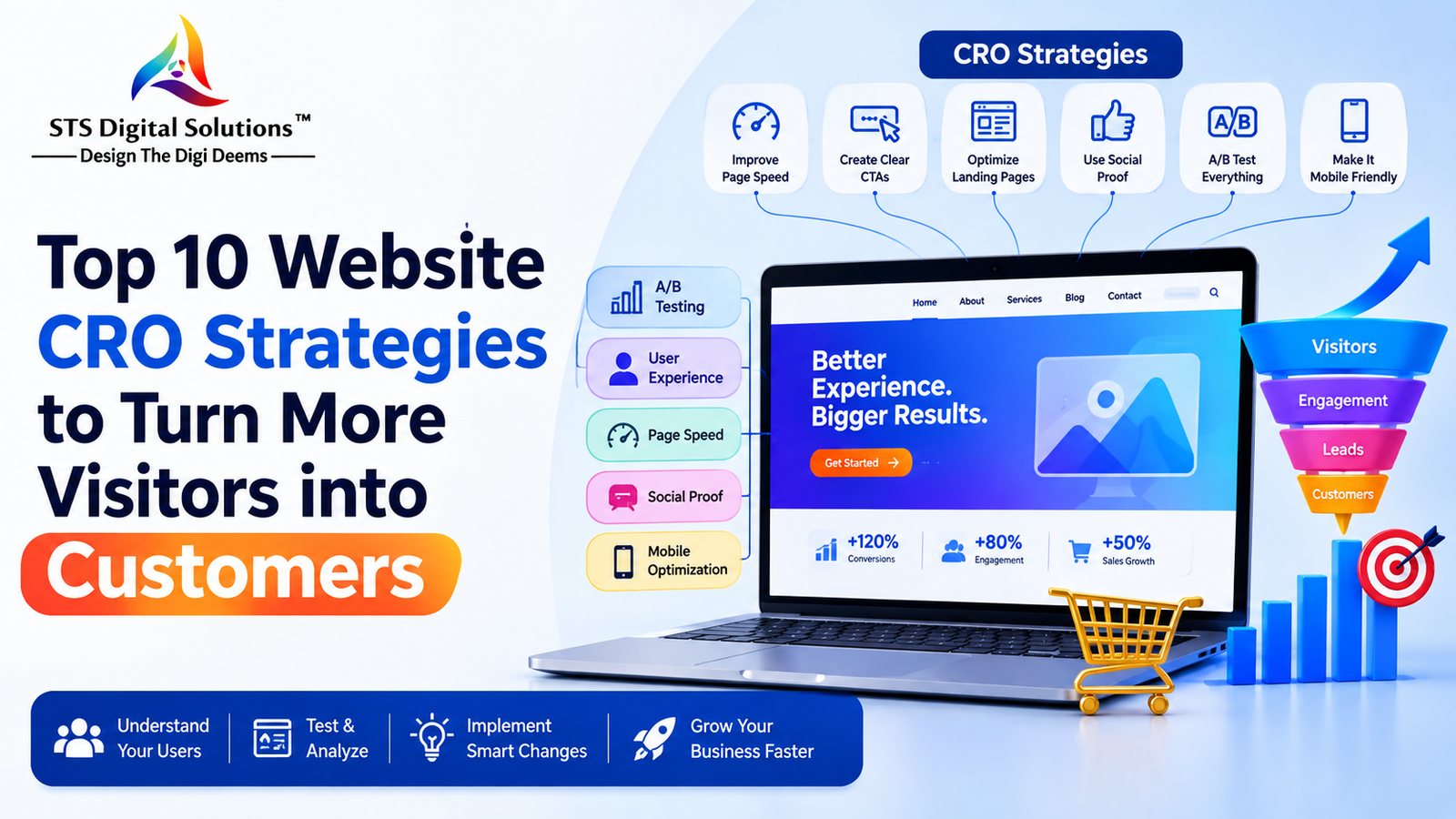
Top 10 Website CRO Strategies to Turn More Visitors into Customers
A company may spend months optimizing its website, investing significant resources into advertising campaigns and attracting thousands of visitors to their site, but be surprised by poor results in terms of conversions and sales.
It's not always about attracting more traffic.
The visitor may enter a website that looks absolutely perfect but leaves since there is no clear message. The customer finds the needed item but decides not to make a purchase since there are no trust elements. He wants to ask a question but gets stuck while filling out the long form.
That is when conversion rate optimization becomes useful.
Conversion Rate Optimization isn't about convincing each visitor to make a purchase right away. It's all about identifying what makes people hesitate and eliminating extra obstacles, thus making the next step easy for qualified visitors.
For e-commerce, it will be a purchase. For service companies, it will be a consultation request. For SaaS, it will be trying out the product.
It is all about getting more out of existing traffic.
Why Does CRO Matter If Website Traffic Is Not Enough?
Website traffic is generally considered the primary indicator of website success. More traffic provides more chances, yet not always enough to ensure business development.
Think about two websites, each of which gets 10,000 visits per month. The first one attracts 100 qualified leads while the other one attracts 300. The latter uses its traffic more efficiently than the former one.
This is why CRO strategies require as much attention as SEO, paid, and social media promotion.
Today's users have many options. They research brands, analyze reviews, compare prices, and test credibility before making any decision. Websites with high levels of friction may miss their chance even though their marketing activities were rather effective.
10 CRO Strategies That Can Increase Conversions
1. Make the Value Proposition Immediately Clear
Visitors should understand what a business offers, who it serves, and why it is worth considering without having to search through multiple pages.
The headline, supporting copy, and primary call to action should work together to communicate the core value.
For example, a generic headline such as “Innovative Digital Solutions for Modern Businesses” may sound professional but tell visitors very little. A more specific message can communicate the service, audience, and outcome much faster.
Clarity reduces cognitive effort.
2. Simplify Website Navigation
A visitor who cannot quickly find the information they need is unlikely to keep searching indefinitely.
Navigation should reflect how users think about the business rather than how the organisation is structured internally.
Important services, products, pricing information, contact options, and supporting resources should be easy to locate. Excessive menu items can create decision fatigue, while vague labels can make useful information difficult to discover.
Good navigation quietly guides users toward their next step.
3. Strengthen Calls to Action
A call to action should tell visitors what happens next.
“Submit” is functional but rarely compelling. Depending on the context, alternatives such as “Request a Consultation,” “Get a Quote,” or “Start Your Free Trial” can provide greater clarity.
The CTA should also match the visitor's stage in the buying journey. Someone discovering a business for the first time may not be ready to make a purchase, but they may be willing to download a guide, explore a service, or speak with an expert.
Strong CRO strategies align calls to action with user intent rather than pushing every visitor toward the same conversion.
4. Reduce Friction in Forms and Checkout
Long forms can discourage enquiries. Complicated checkout processes can cause customers to abandon purchases.
Businesses should review every field and step and ask whether it is genuinely necessary.
A service enquiry may not need ten questions before someone can speak to the sales team. An online store should make product selection, payment and delivery information as straightforward as possible.
The principle is not to remove useful information. It is to remove unnecessary effort.
5. Build Trust Before Asking for Commitment
Visitors often hesitate because they are uncertain about the business rather than the product itself.
Trust can be strengthened through authentic customer reviews, testimonials, case studies, transparent policies, professional credentials, security information, and clear contact details.
For B2B services, evidence of previous work and relevant expertise can be particularly persuasive.
Trust signals should appear where uncertainty occurs. A testimonial near a service CTA, for example, may be more useful than testimonials hidden on a separate page.
6. Improve Landing Pages for Specific Campaigns
Sending every advertising visitor to the homepage is rarely the most effective approach.
A dedicated landing page can align the headline, offer, imagery,y and call to action with the advertisement that brought the visitor there.
If an advertisement promotes a particular service, the landing page should immediately continue that conversation instead of forcing visitors to search through the website.
This message continuity can reduce confusion and create a more focused conversion journey.
7. Use Social Proof Strategically
People naturally look for evidence that others have had a positive experience before making decisions.
Reviews, ratings, customer stories, project outcomes, and testimonials can provide that evidence.
However, social proof becomes less convincing when it feels generic or exaggerated. Specific testimonials that explain the customer's problem, experience, and outcome are usually more useful than vague statements such as “Great service!”
The strongest proof answers the question a hesitant customer is already asking: “Can this business actually deliver what it promises?”
8. Optimise Website Speed and Mobile Experience
A conversion-focused website must work well across devices.
Mobile visitors should not have to zoom into text, struggle with small buttons or wait for heavy pages to load. Forms, menus, product pages and payment experiences should be tested on realistic mobile conditions.
Speed also matters because delays can interrupt the user's decision-making process.
Website optimisation is therefore not merely a technical SEO concern. It is part of the customer experience and can directly influence whether visitors continue their journey.
9. Use Data Instead of Assumptions
One of the biggest mistakes businesses make is changing their website based on personal opinions.
A manager may prefer one headline while a designer prefers another. Neither preference proves which version will convert better.
Analytics, user behaviour, heatmaps, session recordings, customer feedback, and controlled A/B testing can provide stronger evidence.
Not every website has enough traffic for statistically robust experiments, so businesses should choose testing methods according to their traffic volume and decision-making needs.
The objective is to replace guesswork with evidence wherever possible.
10. Personalise the Conversion Journey
Not every visitor has the same needs.
A returning customer may need different information from someone visiting for the first time. A visitor arriving through a product-specific advertisement may respond differently from someone entering through an informational blog.
Personalisation can involve relevant recommendations, location-specific information, returning-user experiences, or content matched to the visitor's stage in the buying journey.
The important principle is usefulness. Personalisation should make the experience more relevant rather than make visitors feel monitored.
How to Know Which CRO Strategy to Use First
Businesses often make the mistake of implementing ten changes simultaneously.
A better approach is to identify the biggest source of friction first.
Look at the complete customer journey and ask where the largest drop-off occurs. If visitors leave immediately, messaging and landing-page relevance may need attention. If they explore products but abandon carts, checkout or pricing transparency may be the issue. If they reach a contact form but rarely submit it, form friction or trust may be limiting conversions.
This prioritisation makes CRO strategies more systematic.
A useful framework is to consider the potential impact of a change, the evidence supporting it, and the effort required to implement it. High-impact improvements supported by strong evidence should generally receive priority.
Common CRO Mistakes That Can Hurt Results
Conversion optimisation can fail when businesses focus too heavily on isolated numbers.
A higher click-through rate does not necessarily mean more revenue. A shorter form may increase submissions but reduce lead quality. A discount may increase orders while reducing profitability.
This is why conversion rate should be evaluated alongside business outcomes.
Another common mistake is copying competitors without understanding why their approach works. A strategy successful for one audience may perform poorly for another because expectations, products, and buying journeys differ.
CRO should therefore be treated as an evidence-led process rather than a collection of website design tricks.
Recommendations for Building a Better Conversion Strategy
Start by establishing a baseline. Measure current conversion rates, important user journeys, lead quality, sales, and relevant engagement metrics.
Next, identify the pages that matter most commercially. These may include landing pages, service pages, product pages, pricing pages,s and checkout screens.
Then collect qualitative evidence. Speak with customers, review support questions, and identify objections that repeatedly appear during the buying process.
After that, prioritise improvements based on evidence and business impact.
Finally, monitor what happens after implementation. A successful change should improve meaningful outcomes rather than simply produce a more attractive interface.
The best CRO strategies are not permanent formulas. They evolve as customer expectations, products, competitors,r,s and market conditions change.
Closing Thoughts
A website does not become effective simply because it looks modern. Its real business value comes from how effectively it helps the right visitors understand an offer, trust a brand,n,d and complete the next appropriate action.
That is why CRO strategies should be considered alongside SEO, paid advertising, content and website development. Bringing more visitors to a website is only one part of digital growth. Helping those visitors move confidently toward meaningful outcomes is equally important.
For businesses looking to improve their digital performance, STS Digital Solutions can support the broader process through website development, SEO, digital marketing and conversion-focused digital solutions. With the right combination of user insight, testing, nd continuous improvement, a website can become more than an online presence;e it can become a stronger engine for qualified leads and sustainable business growth.

Sahil Goyal
Founder & CEO – STS Digital Solutions
Sahil Goyal is an experienced digital marketing strategist and growth leader, who has assisted some of the most successful BFSI & Healthcare, Automotive, and E-Commerce brands to attain sustainable and quantifiable digital success. Being the Founder & CEO of STS Digital Solutions, he spearheads performance-oriented actions in SEO, Digital Marketing, Social Media Marketing, Performance Marketing, E-Commerce Marketing, which assist business to create substantial online presence and generate continuous growth in revenues.
He is a pragmatic and data-driven consultant that focuses on the development of the scalable digital strategies wherein technical SEO, high-quality content, paid advertising, and performance marketing are merged. He is of the opinion that marketing should be aligned with the obvious business objectives, such as more organic traffic, stronger social media brand awareness, paid campaigns that are more ROI-friendly, or more e-commerce brands conversions.
Maximize Your Online Impact - Contact Our Experts!