


Top 7 Growth Marketing Experiments Every Growing Brand Should Try
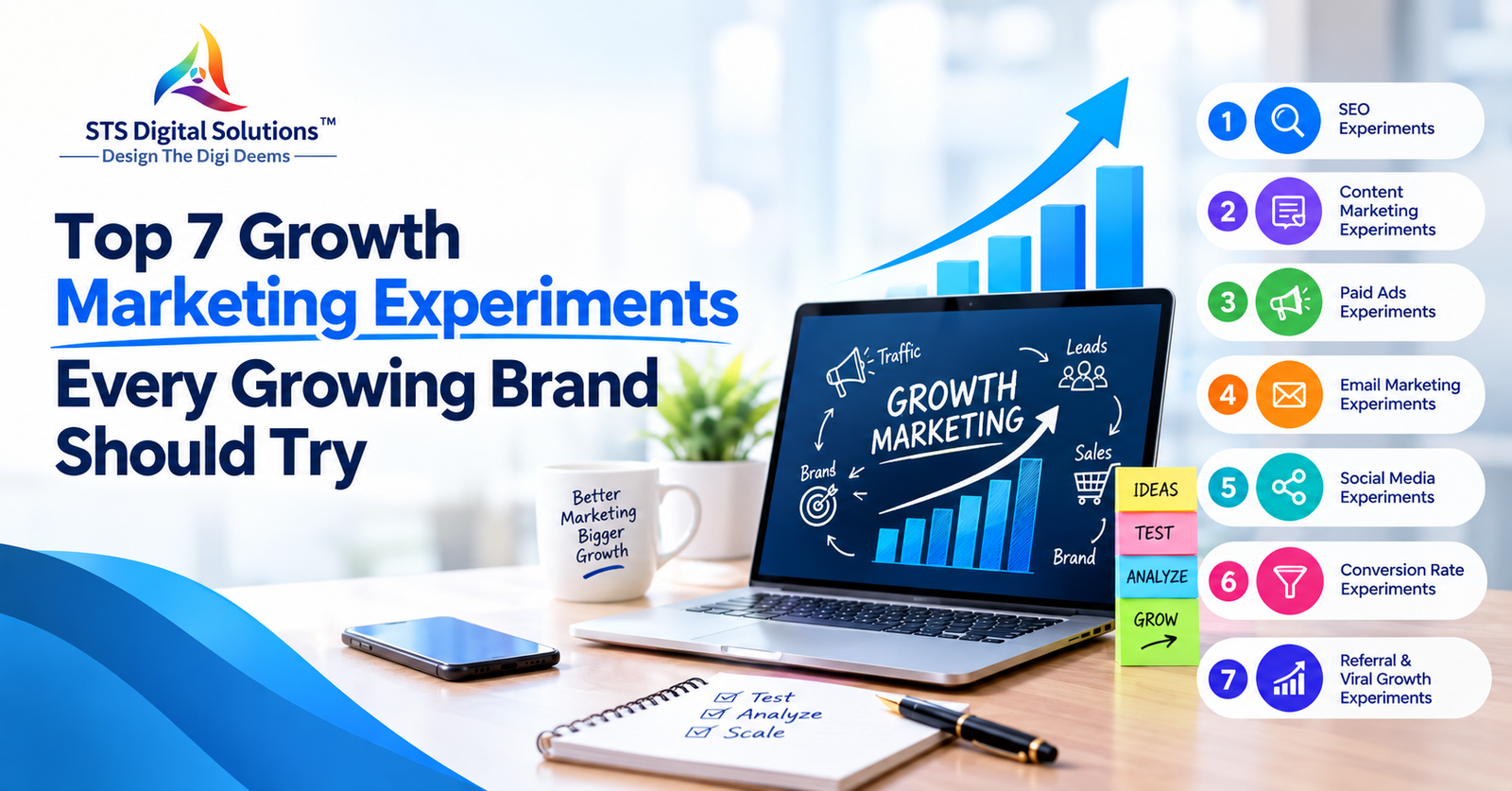
Building up a brand is not merely about placing advertisements or making posts on social media sites. What companies need to know is what attracts their audience, what motivates them, and what kinds of marketing efforts actually produce any meaningful outcome. It is here that experiments in growth marketing come in handy. Companies can benefit from working with Best Digital Marketing Services in Delhi.
Businesses can do digital marketing through strategic orientation, audience knowledge, content creation, search engine optimization, and performance through STS Digital Solutions. For growth marketing, firms have to try a number of things and experiment with them so that they learn from the process and get better at them.
What Makes Growth Marketing Experiments Effective in Digital Marketing Services?
A growth marketing experiment is an experiment that is well-designed to give an answer to a specific marketing question. Instead of experimenting on various factors, a business may experiment on only one key factor and observe how its target audience reacts.
For example, there could be a need to test if a compact landing page is successful in bringing more inquiries, whether a different heading increases engagement, and whether education-related content drives more relevant traffic. Each of the tests must have a clearly defined objective, an expected result, and a future course of action. The objective is not just to do more tests. Rather, it is to understand how to make the test work for the specific audience and use the understanding in future decisions.
1. Test Different Landing Page Headlines
Your landing page heading is something that catches the attention of your visitors first. If it fails to convey what your page is all about, your visitors may leave your page after that very first point. An effective test that can be done is testing headlines on a page that does not have too many variations.
Headline Approach |
Main Focus |
|
Service-focused |
Clearly explains what you offer |
|
Problem-focused |
Addresses a customer concern |
|
Benefit-focused |
Highlights the value for the customer |
|
Audience-focused |
Speaks directly to a specific customer group |
For instance, an organization may decide to compare a generic headline like “Digital Marketing Solutions” with a specific headline that talks about addressing the needs of its customers. This is not for the purpose of making the headline longer or more promotional. This is about figuring out which message best conveys the offer to the target audience.
2. Experiment With Different Content Formats
An emerging brand must not believe that all customers would like to be engaged with the same kind of content. Some customers might like articles, while some may respond better to videos or carousels and even educational content. Rather than come up with completely new themes depending on the format, a business could use a single theme and adapt it into various forms. Some examples of such adaptations would be a blog post, a video, a carousel, and an infographic.
The kind of experiment can also help determine which designs produce engagement and which designs motivate people to visit the website or seek more information on the service provided. Quality and relevance are more important than having an increase in the number of articles published.
3. Run A/B Tests on Calls-to-Action
The Call to Action urges the visitor to take the next step in action. A minor tweak in the CTA wording could result in better instructions about the target action. Instead of using the same CTA across the entire site, companies can opt for "Get Started," "Speak to an Expert," "Request More Information," and "View Our Services."
The appropriate CTA will depend on the target market, the offer being made, and where the individual stands in the buying cycle. First-time buyers might not need the same type of call-to-action as those who have already visited the service pages. The important thing here is to track what counts for the business rather than just focusing on clicks.
4. Test Audience Segmentation in Paid Campaigns
One ad message may not be applicable to all possible consumers. Segmentation of the audience enables companies to design more targeted campaigns depending on various parameters such as geographical location, consumer demands, type of industry, browsing behavior on their websites, etc. In addition, one who has visited the service website previously may react differently compared to another who is encountering the brand for the first time. The two groups need to be tested with different messages so that we can gain valuable information about them.
Audience |
Possible Marketing Focus |
|
New visitors |
Brand awareness and basic value proposition |
|
Website visitors |
Relevant services and benefits |
|
Returning visitors |
Stronger engagement or enquiry message |
|
Specific customer segment |
Needs-based messaging |
It is intended to analyze how various audiences react to different messages, thereby improving future communication campaigns based on the results obtained.
5. Experiment With SEO Content Topics
SEO is not just about choosing keywords. Increasingly important for rising brands is awareness of the type of inquiries, worries, comparisons, and issues prospective consumers have. The business may use various content themes depending on the search intent of the visitor. For example, information content may provide answers to frequently asked questions, problem content can solve the problems that the customer is facing, while comparison content can be used to evaluate alternatives.
This technique allows companies to see what types of content pull in visitors that have a connection to their business. When companies are in search of the Best Digital Marketing Services in Delhi, another factor to take into account is how the company manages to link up SEO efforts with the goals of the marketing campaign as well. Rankings can be useful, but there’s more to the story.
6. Test Different Lead Magnets
Not all people who visit the website will immediately ask for anything. The appropriate lead magnet will provide the right incentive for the potential customer to keep in touch with the brand. Depending upon the type of business and audience, it can be anything from a checklist to a guide or consultation.
In the test, both the type of resources as well as the presentation method could be considered. For example, the company could consider a downloadable guide versus a consulting offer to determine which one brings in more appropriate inquiries. The lead magnet should address some actual issue or question. The reason why it exists is not only to provide value but also to make the subsequent step for the client natural.
7. Experiment With Retargeting Messages
Not all people become customers on their very first encounter with an organization. The practice of retargeting helps organizations reconnect with those who have expressed some interest. Rather than displaying the same message to all, companies have the option to try different messages depending on the history of activity on their website. People who saw a services page might require additional information regarding their services, whereas people who read educational articles might need some further resources.
This form of communication should be in line with the previous experience of the customer and be in continuity with the previous experience. This helps ensure that the retargeting does not involve merely repeating the advertisement.
How to Measure Your Marketing Experiments
In any experimental procedure, a question must come first. You have to determine what it is that you want to know, what will be varied in the experiment, who will take part in your testing procedure, and what outcome will assist you in making a decision.
Element |
What to Define |
|
Hypothesis |
What you expect to happen |
|
Variable |
What you are changing |
|
Audience |
Who will participate |
|
Metric |
What you will measure |
|
Timeframe |
How long you will test |
|
Next step |
How you will use the learning |
It is also important to note that more than one alteration at any one time must not be carried out. If someone modifies his headline, target group, offer, creative, and landing page simultaneously, there will be no way to know what alteration has caused that result. The metric needs to match the objective of the whole campaign as well. One campaign aiming for inquiries has to be viewed differently from the one focused on awareness.
Turning Experiments Into a Long-Term Growth Strategy
The actual worth of growth marketing lies in learning from every single test. Every single test is not supposed to provide the expected outcome. It can help you learn about the audience that reacts in a different way, the messaging strategy that is not good enough, and so on. Businesses can keep an easy track of their experimentation that includes the initial hypothesis, the change, the people involved, the outcome, and what to do next.
It leads to a constant learning process. Rather than basing its decision-making for major marketing initiatives on assumptions alone, a company can continually improve its strategy by gaining learnings from its marketing initiatives.
Why Testing Matters for Digital Marketing Services
There are several related elements associated with digital marketing, such as SEO, content creation, social media, pay-per-click, landing pages, and conversion. What is effective in one company does not have to be equally effective in another. This is the reason that experimentation must always relate to the audience, offer, goals, and journey of the business’s customers.
For businesses looking at the Best Digital Marketing Services in Delhi, it is important to know about the agency's approach to the process of testing and measurement. Find out what will be tested and how results will be analyzed and used for future planning. With a structure in place, companies can improve their performance progressively rather than change directions continuously without knowing what triggered the results.
Final Thoughts
Growth marketing is all about creating a test-and-learn-and-grow process that works. It could range from testing headlines on landing pages and their structure, segmentation, SEO themes, lead magnets, calls-to-action, to even retargeting to help a brand learn more about its target audience.
STS Digital Solutions will be able to assist companies in creating a structured digital marketing strategy that encompasses strategic thinking, content creation, SEO, and performance-driven experimentation. It is not about testing everything, but asking the right questions, measuring results, and learning from what is learned.
Frequently Asked Questions
1. What is a Growth Marketing Experiment?
This is an experiment that helps in finding out what works best for our audience in terms of marketing, content, or campaigns. It allows businesses to make their marketing decisions based on empirically tested methods.
2. Why do Growing Brands Need to Conduct Experiments on Their Marketing?
Businesses can discover what works for their audiences through experiments and also areas that can be improved through marketing experiments. Through conducting these experiments, businesses can help improve content and campaigns.
3. What can be tested in digital marketing?
Some of the things that can be tested include landing page headings and CTA, format of the content, audiences, SEO topics, lead magnets, advertising messages, and retargeting campaigns. It all depends on the goal and target audience of the business.
4. What is the method for measuring the success of a marketing experiment?
This can be determined by the objectives set for the experiment. Businesses have the option of using metrics such as enquiries, conversions, site interactions, content interactions, etc., depending on the nature of the campaign.
5. How does a digital marketing agency assist in running growth experiments?
A digital marketing agency helps businesses conduct growth experiments in various ways.

Sahil Goyal
Founder & CEO – STS Digital Solutions
Sahil Goyal is an experienced digital marketing strategist and growth leader, who has assisted some of the most successful BFSI & Healthcare, Automotive, and E-Commerce brands to attain sustainable and quantifiable digital success. Being the Founder & CEO of STS Digital Solutions, he spearheads performance-oriented actions in SEO, Digital Marketing, Social Media Marketing, Performance Marketing, E-Commerce Marketing, which assist business to create substantial online presence and generate continuous growth in revenues.
He is a pragmatic and data-driven consultant that focuses on the development of the scalable digital strategies wherein technical SEO, high-quality content, paid advertising, and performance marketing are merged. He is of the opinion that marketing should be aligned with the obvious business objectives, such as more organic traffic, stronger social media brand awareness, paid campaigns that are more ROI-friendly, or more e-commerce brands conversions.
Maximize Your Online Impact - Contact Our Experts!