


What Every Growing Business Should Know Before Choosing an E-commerce Platform
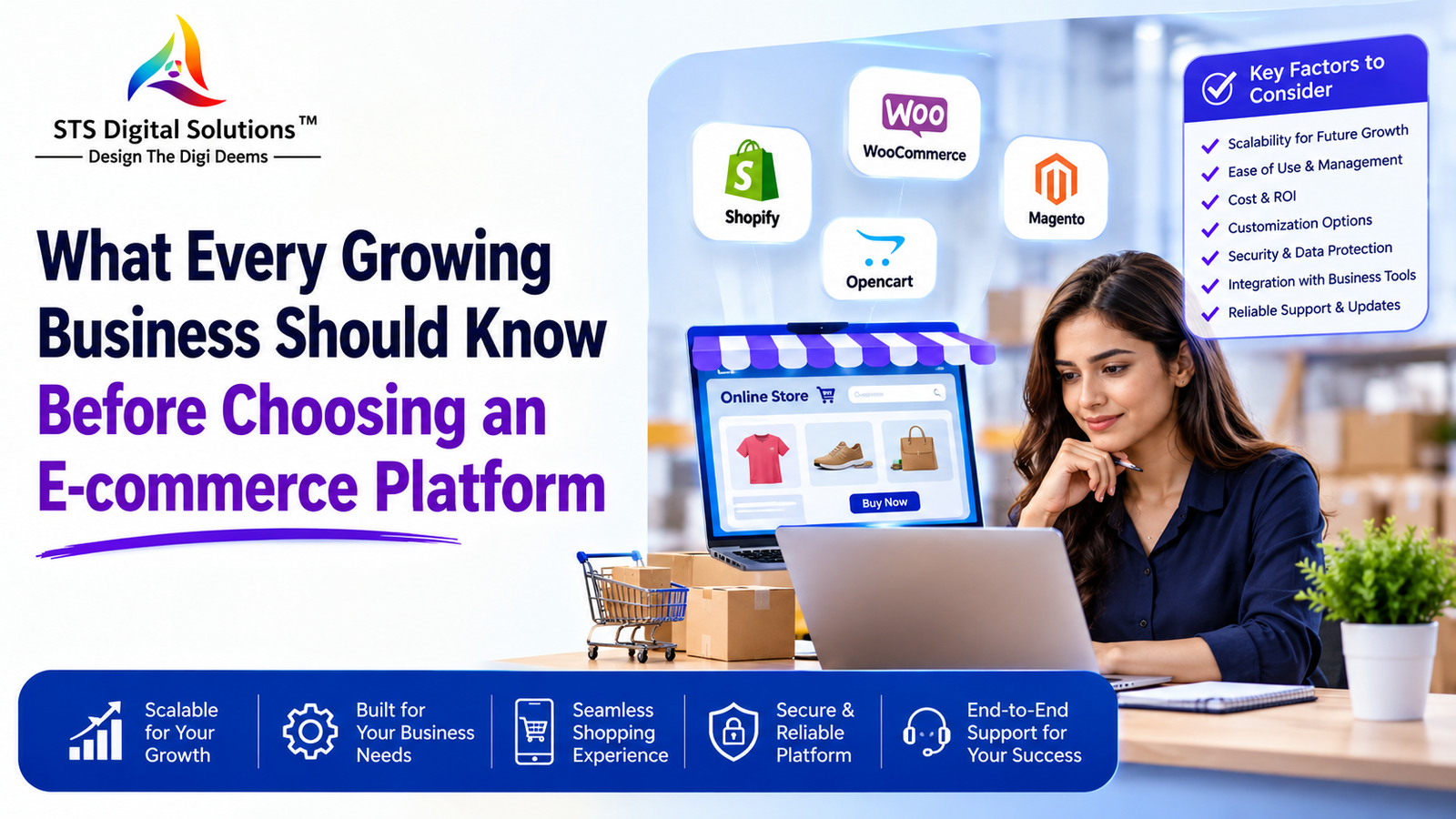
The choice of an e-commerce platform is among the most crucial technology choices that a developing online business has to make. At first, any platform might seem sufficient, since the primary concern at the early stages is only to get the products listed and start receiving orders. However, as the company grows, the requirements also change rapidly.
More products lead to larger inventories; more clients lead to bigger requirements regarding speed of operation, payment methods, delivery, personalization, and customer service. The marketing campaigns will lead to increased traffic. Integration with payment systems, CRM software, marketplaces, analytics, and logistics also becomes more essential.
That is why the choice of an e-commerce platform should not be made just based on popularity or cheapness of the solution. The platform has to fit the current business model and offer enough space for further development. Here, the services of E-Commerce Marketing Services in Bangalore can prove very useful.
Don’t Start With Comparing Features – Begin With Your Needs
It’s one of the most common mistakes made by businesses to start comparing different platforms according to features without understanding their needs first.
As a developing business, you should start by taking into account your products, target audience, number of orders, sales channels, payments, inventory, delivery system, marketing, and the further development of the business. A platform that works flawlessly with a small product catalogue can turn out complicated when expanding your business to hundreds or thousands of products.
That’s why you should choose a platform that suits your business model and not vice versa.
For example, a business with a small selection of products will value ease and quickness, while a more developed eCommerce business will need such features as an advanced inventory system, different payment options, automation, etc.
Scalability Should Be a Priority From Day One
Growth is the objective of an eCommerce business, but growth can expose weaknesses in the technology infrastructure.
As traffic, product listings, orders, and customer accounts increase, the platform needs to continue delivering a smooth experience. Slow-loading pages, checkout issues, poor search functionality, or system downtime can directly affect sales.
A scalable eCommerce platform should be capable of handling increasing traffic and operational complexity without requiring the business to rebuild its entire online store every time it reaches a new stage.
Businesses should therefore consider not only what a platform can do today but also how it will support them two or three years from now.
Mobile Experience Can Directly Influence Conversions
Customers increasingly interact with online stores through smartphones. This makes mobile usability an essential consideration when choosing an eCommerce platform.
A store should provide easy navigation, fast page loading, clear product information, convenient checkout, and payment options that work smoothly on smaller screens.
A platform may offer impressive desktop functionality, but if the mobile experience is difficult to use, the business can lose potential customers before they complete a purchase.
This is particularly important for brands investing in paid advertising and social media marketing, because a significant portion of the traffic generated through these channels may arrive on mobile devices.
SEO Capabilities Should Not Be an Afterthought
An eCommerce platform can have a direct impact on how easily a store can be optimised for search engines.
Businesses should examine whether the platform provides sufficient control over elements such as page titles, meta descriptions, URLs, product pages, category pages, structured data, image optimisation, internal linking, redirects, and indexing.
This becomes increasingly important as the product catalogue grows.
A poorly structured store can create duplicate pages, inefficient navigation, indexing problems, or weak category structures that make organic growth more difficult. On the other hand, a platform that supports sound SEO practices can provide a stronger foundation for long-term visibility.
For businesses working with E-Commerce Marketing Services in Bangalore, SEO should therefore be considered during platform selection rather than added after the website has already been built.
Your Platform Should Support Your Marketing Strategy
An eCommerce website is not just a place where customers complete purchases. It is the centre of many marketing activities.
SEO brings organic visitors, paid advertising generates targeted traffic, social media creates product discovery, email marketing brings customers back, and remarketing helps reconnect with people who did not purchase during their first visit.
The eCommerce platform should support these activities through integrations, tracking capabilities, analytics, product feeds, promotional tools, and customer data.
For example, if a brand plans to run shopping campaigns, its product catalogue needs to be structured properly. If it wants to build email automation, customer information needs to be accessible in a useful way. If conversion tracking is inaccurate, marketing teams may struggle to understand which campaigns are actually generating revenue.
The technology platform and marketing strategy therefore need to work together.
Product Management Becomes More Complex With Growth
Managing ten products is very different from managing ten thousand.
As an online store expands, businesses may need multiple product variations, categories, attributes, pricing structures, stock locations, bundles, discounts, and product relationships.
A suitable eCommerce platform should make it easier to organise this information rather than creating additional administrative work.
Businesses should also consider how easily product information can be updated and synchronised across different sales channels. Manual processes that seem manageable in the beginning can become expensive and error-prone as the business grows.
Checkout Experience Matters More Than Many Businesses Realise
A customer can spend several minutes browsing products and still leave the website because the checkout process is confusing.
A strong eCommerce platform should support a checkout experience that is simple, transparent, secure, and easy to complete across devices.
Businesses should evaluate the number of steps involved, guest checkout options, payment methods, shipping information, coupon functionality, error handling, and order confirmation.
Every unnecessary step can create friction. For growing brands, reducing this friction can have a meaningful impact on conversion rates.
Payment Options Should Match Your Customers
Payment behaviour varies between markets and customer groups. An eCommerce platform should therefore support the payment methods that are relevant to the target audience.
For businesses operating in India, this may include options such as UPI, cards, net banking, digital wallets, and other locally relevant payment methods. International businesses may need multiple currencies and region-specific payment gateways.
The important consideration is not simply how many payment methods are available but whether they can be integrated reliably and provide a smooth customer experience.
Integrations Can Determine How Efficiently You Operate
As an eCommerce business grows, it rarely operates through the website alone.
The store may need to connect with payment gateways, shipping providers, accounting software, CRM platforms, inventory systems, marketplaces, customer support tools, analytics platforms, and marketing automation software.
Before selecting a platform, businesses should identify the integrations they already use and the ones they are likely to need in the future.
A platform with strong integration capabilities can reduce manual work and help different parts of the business operate from connected data.
Analytics and Tracking Need to Be Built Into the Strategy
You cannot improve what you cannot measure.
An eCommerce platform should make it possible to understand how visitors interact with the store and where customers drop out of the purchase journey.
Businesses should be able to track important activities such as product views, searches, add-to-cart actions, checkout progression, purchases, repeat orders, and revenue.
This data becomes particularly valuable when combined with digital marketing campaigns. Businesses can use it to understand which channels bring valuable customers, which products generate the most interest, and where improvements are required.
For brands investing in E-Commerce Marketing Services in Bangalore, accurate analytics can help connect marketing performance with actual business outcomes.
Website Speed and Core User Experience Matter
A visually attractive online store is not enough if it takes too long to load.
Customers expect eCommerce websites to respond quickly, particularly when they are browsing products on mobile networks. Slow experiences can affect engagement, conversions, and search performance.
When evaluating a platform, businesses should consider how efficiently it handles images, scripts, product pages, checkout processes, and increasing traffic.
It is also important to assess the flexibility available to developers and marketing teams for improving performance as the store evolves.
Security Should Never Be Compromised
An eCommerce website handles valuable customer and business information. This makes security a fundamental consideration rather than an optional feature.
Businesses should understand how the platform approaches payment security, customer data, access control, updates, backups, and other security requirements.
The development team should also follow secure coding and implementation practices when customising the platform.
A secure store helps protect both the business and the customer while supporting long-term trust.
Think About Customisation Before Making the Final Decision
Some businesses can operate successfully with standard templates and built-in features. Others eventually need custom functionality to support their business model.
Before choosing a platform, businesses should determine how much customisation they are likely to require.
This could involve custom product configurations, specialised checkout processes, subscription models, loyalty programmes, unique customer dashboards, advanced search, or integrations with internal systems.
The ideal platform should provide enough flexibility without making every small change unnecessarily expensive or technically complicated.
Consider the Total Cost Instead of the Starting Price
A platform may appear affordable when businesses look only at its initial subscription or setup cost.
However, the actual cost of running an eCommerce store can include hosting, development, themes, plugins, transaction fees, third-party applications, maintenance, security, integrations, marketing tools, and future upgrades.
Businesses should calculate the total cost of ownership rather than selecting a platform based solely on the lowest starting price.
A slightly more expensive platform may prove more cost-effective if it reduces development requirements, supports growth, and integrates efficiently with the rest of the business.
Your eCommerce Platform Should Support Customer Retention.
Acquiring a new customer is only one part of eCommerce growth. Encouraging existing customers to return can be equally important.
A strong platform should support features that make repeat purchases easier and allow businesses to create personalised customer experiences.
Customer accounts, order history, saved preferences, loyalty programmes, personalised recommendations, subscriptions, and targeted offers can all contribute to retention.
The more effectively a platform supports these experiences, the easier it becomes for a brand to build relationships beyond the first purchase.
How E-Commerce Marketing Services In Bangalore Fit Into Platform Selection
Choosing the right platform and choosing the right marketing strategy should not be treated as two completely separate decisions.
A business may invest in an excellent eCommerce platform but struggle to generate sales because its product pages are not optimised, its category structure is weak, its advertising campaigns are poorly tracked, or its checkout experience creates unnecessary friction.
This is why E-Commerce Marketing Services in Bangalore can play an important role in the broader eCommerce strategy. Marketing professionals can help businesses understand how the platform needs to support SEO, paid campaigns, product discovery, conversion optimisation, analytics, remarketing, and customer retention.
The platform becomes the foundation, while marketing brings the right audience to that foundation and helps turn visitors into customers.
Questions to Ask Before Choosing an eCommerce Platform
Before committing to a platform, businesses should look beyond demonstrations and sales presentations.
They should ask whether the platform can handle their expected product and order volume, whether it integrates with their current systems, how much control they will have over SEO, what happens when traffic increases, how customisation works, and what support is available when technical problems arise.
It is also worth understanding how easy it will be to migrate data if the business eventually needs to change platforms.
These questions can prevent businesses from making a decision that works in the short term but becomes expensive as the company grows.
Choosing an eCommerce Platform Is a Long-Term Business Decision.
The right eCommerce platform should make growth easier, not create new limitations every time the business reaches another milestone.
Growing businesses need to think beyond product listings and checkout. They need to consider SEO, marketing integrations, mobile experience, analytics, security, performance, inventory, payments, customer retention, and scalability.
The platform should support the entire customer journey from the moment a potential customer discovers the brand to the point where they make a purchase and eventually return for another one.
That is why platform selection deserves the same level of strategic thinking as branding, marketing, and product development.
Final Thoughts
For a growing eCommerce business, the platform is more than the technology behind the online store. It influences how products are discovered, how customers navigate the website, how payments are processed, how marketing campaigns are measured, and how efficiently the business can scale.
The right platform should therefore support the complete customer journey while giving the business enough flexibility to adapt as its products, audience, and marketing requirements grow. From SEO and mobile experience to integrations, analytics, security, checkout, and customer retention, every factor can influence the long-term performance of an online store.
This is where STS Digital Solutions can help businesses build a more connected eCommerce growth strategy. With expertise across eCommerce SEO, digital marketing, website development, performance marketing, and other digital solutions, STS Digital Solutions can help brands align their technology and marketing efforts with their business goals.
For businesses looking for E-Commerce Marketing Services in Bangalore, partnering with STS Digital Solutions can be a step towards creating an eCommerce presence that is not only easier to manage today but also better prepared for tomorrow's growth.

Sahil Goyal
Founder & CEO – STS Digital Solutions
Sahil Goyal is an experienced digital marketing strategist and growth leader, who has assisted some of the most successful BFSI & Healthcare, Automotive, and E-Commerce brands to attain sustainable and quantifiable digital success. Being the Founder & CEO of STS Digital Solutions, he spearheads performance-oriented actions in SEO, Digital Marketing, Social Media Marketing, Performance Marketing, E-Commerce Marketing, which assist business to create substantial online presence and generate continuous growth in revenues.
He is a pragmatic and data-driven consultant that focuses on the development of the scalable digital strategies wherein technical SEO, high-quality content, paid advertising, and performance marketing are merged. He is of the opinion that marketing should be aligned with the obvious business objectives, such as more organic traffic, stronger social media brand awareness, paid campaigns that are more ROI-friendly, or more e-commerce brands conversions.
Maximize Your Online Impact - Contact Our Experts!