

Why Can a Website With Strong Organic Traffic Still Have Poor Conversion Performance?
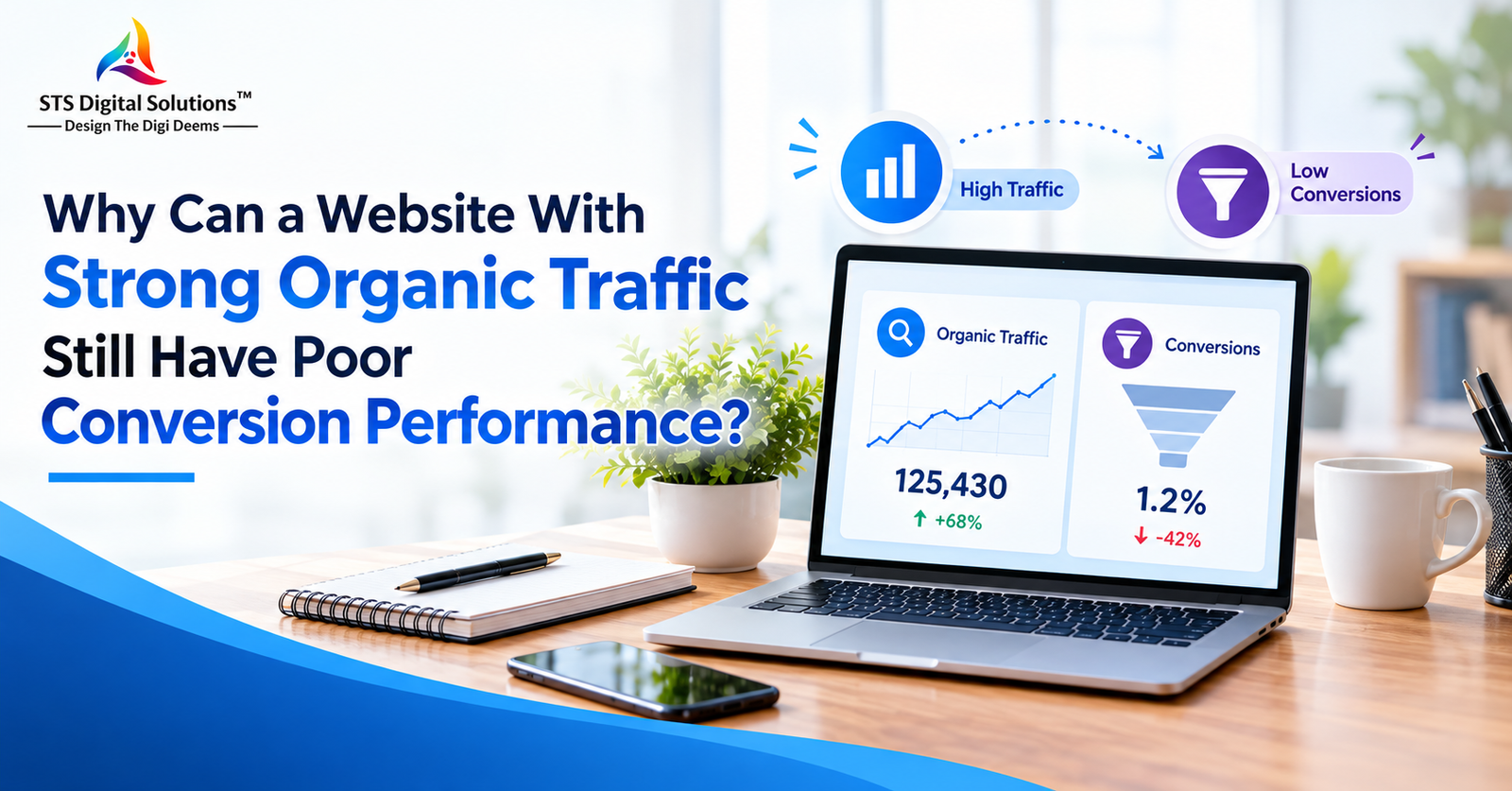
An online business may receive thousands of hits from search engines but have difficulty in generating inquiries, sales, or leads. High organic traffic means that people can find your site, but it doesn’t mean that they will do anything about it. Conversion depends on a number of things. Some of these include website design, content, usability, and trust. At STS Digital Solutions, we understand that companies require more than just good search rankings.
By partnering with a Website Designing Company In India, companies can be able to spot website problems that influence the engagement of users and enable them to convert into customers more easily. In cases where people visit a website but do not contact the company or buy anything from the website, there is usually some gap between what they expect and what they get. This knowledge helps companies improve the performance of websites without necessarily focusing on increasing traffic.
Understanding the Difference Between Organic Traffic and Conversions
Organic visits refer to the number of visitors who access a particular site by using unpaid searches in search engines. The success of a conversion is defined by the success that is achieved in the completion of a certain activity such as completing an enquiry, requesting a quote, arranging an appointment, or even buying some goods or services. Each metric serves a separate purpose. There may be cases where a particular site performs very well in ranking for a number of key phrases, but the visitors are not in need of the service offered there.
In such cases, a web development company will attract users looking for ideas for website design. Nonetheless, most of them might be in search of something rather than thinking of hiring a service provider. If the website does not cater to the needs of such potential clients who are shopping around, then the visitors will probably not make enquiries. The main aim should be to bring in the right visitors and make them do something useful.
How Website Design Affects Conversion Performance
Web design is a major factor influencing visitors' exploration of a business, understanding its services, and their decision on whether to keep browsing. A well-designed website will not serve its purpose if the design itself makes the user’s task difficult.
1. Confusing Website Navigation
It is critical for guests to be able to access key information without spending too much time trying to navigate through the various web pages. Having complex menus, confusing categories of services provided by the organization, and disorganized information may cause frustration for the visitors. Failing to provide such key pieces of information in an easy-to-access manner causes guests to move on to other websites.
Companies should structure their pages in an organized manner, provide clear navigation labels, and put vital information in places where users can easily locate it. The correct structure will make the browsing process much easier for them.
2. Poor Mobile User Experience
A site that performs perfectly in the desktop version can experience some issues if viewed via a mobile phone. The buttons might be too tiny, the text not clear, there could be overlaps, and forms could be too difficult to fill. With responsive web design, your website design would automatically adapt to the new screen size while still making sure that the content is readable. But then, it is not enough to make sure that the site is viewable on a small screen. It is also important that the buttons are tap-friendly.
The mobile testing of critical pages will ensure any usability issues that may have been ignored are caught. Improved mobile usability would ease the burden on those clients who intend to make their inquiries and purchase from them.
3. Slow Page Loading Speed
The audience expects pages on websites to be accessible in a short time span. Slowly loading pages or failure of response from any part can result in annoyance on behalf of the visitor who will likely abandon visiting other parts of the site. The reason for such a problem can be heavy image files or scripts and poor use of caching.
Improvements such as optimising the size of images, eliminating unneeded scripts, and reviewing technical settings can help in improving page speed. Page speed is also beneficial in helping visitors interact with services.
Why Website Content May Not Convert Visitors
In spite of the fact that a website draws relevant traffic to itself, it is imperative that the content on the website should be able to provide answers to their queries.
4. Content Does Not Match Search Intent
What is the search intent? It means the intention behind why the user searched a particular search query. Some want to know general information, whereas some compare the service providers and prepare themselves for making a decision. Content that does not relate to the user’s search intent will result in getting clicks but not enquiries. For example, when someone is searching for the price of website design, they need information about the cost associated with it, services included in it, and how to hire one.
There is a need for a company to do research on which keywords are being used by people who visit their website in order to ensure that the landing page caters to the same search intent. Service pages should clearly indicate the services offered.
5. An Unclear Value Proposition
It is important for visitors to know what type of business it is, who its target customers are, and how the services offered help solve their problems. Confusion can be a hindrance for prospective customers to distinguish between service providers. The value proposition must make clear the services offered, their benefits, and the target customers. It is important for businesses to focus on what they do and not on what they promise.
The messaging should be kept consistent throughout the homepage and services page, among others. Once people know the message straight away, they are going to know whether it is worth contacting the business or not.
6. Weak Calls to Action
The call-to-action is a signpost that tells how the next step can be taken. Wrong CTAs would leave people to admire your content while wondering how more they could have been assisted. Buttons such as "Request a Quote," "Contact Our Team," or "Book an Appointment" would be needed depending on what you intend to do with your website. The placement of these buttons would be as important as their presence on the web page. There is no need for companies to puzzle their visitors by offering too many options at once.
Trust Issues That Can Reduce Website Conversions
Someone may be hesitant to get in touch with the organization if the website does not provide the required information to do so. Trust becomes particularly important when consumers are comparing various service providers or purchasing something important.
7. Insufficient Trust-Building Information
A website which does not give much information about its services, team, process of work, and its previous works can make people confused. People need information in order to find out if the company suits their needs. Companies can create a better image of themselves by giving true information about their services, testimonials from real customers if any, samples of their previous works, and contact information.
Claims should always be factual and verifiable. Unfounded assurances can cast doubts rather than motivate the visitor into taking an action.
8. Complicated Contact Forms
Large-sized enquiry forms can dissuade those who want to make enquiries. This means that requiring unneeded details is just a way of making the entire process more difficult. Firms need to seek only the details they need in order to answer the query. A simple enquiry form might contain the names, the contacts, and what the customer wants to enquire about.
The form labels need to be clear, the error messages need to explain what is required, and confirmation should be provided for successful form submissions. Testing will also help identify any broken forms or technical problems that could prevent the inquiries from getting to the business.
How to Measure and Improve Conversion Performance
In order to increase website conversions, there is a need for an organized effort as opposed to just making changes in designs randomly. It is important for businesses to know which pages are bringing people in and where the users are having trouble. Begin by looking at the analytics data and finding landing pages that have organic traffic but not many conversions.
After this, analyze the website through the eyes of the visitor. Make sure that the page satisfies the user’s search query, describes the service properly, loads well, and gives the visitor a clear indication of what to do next. Here are some recommendations on how to increase conversions.
- Enhance landing pages: Make sure your headlines, copy, and calls to action match what the visitor expects.
- Make it easier to navigate: Ensure that services and contact information are easy to locate.
- Make it mobile-friendly: Ensure your website is tested for usability on various devices.
- Evoke trust: Provide accurate information, appropriate examples, and ways to contact you.
- Track important conversions: Track enquiries, qualified leads, sales, or any other important business activity.
- Test changes: Compare the results before and after making changes.
Heatmaps, session recording, and conversion funnel reports (when available) can also be considered by companies to learn more about visitor behavior on significant pages. By combining both, it becomes easier for companies to make informed decisions.
Choosing a Website Designing Company In India for Better Conversions
If poor conversion performance is due to structure, usability, and unclear messaging of the site, professional assistance in designing websites can help solve the problem. But selecting a service should not be based only on comparing portfolios. An ideal Website Designing Company should know how website design, content, behavior, and business goals interact. It should consider the target audience, develop clear page structures, ensure mobile friendliness, and make essential conversion actions simple.
It is necessary to mention that companies must consider ways to measure website performance after the launch. Based on company type, the metrics to evaluate could be inquiry submission, lead quality, conversion rate, abandonment rate, and visits to essential services. It is impossible to assure a better conversion with just a better-designed website. Conversions are based on traffic, prices, competition, services, and the number of customers' requests. Nevertheless, a good design along with proper testing can eliminate obstacles that do not allow visitors to take action.
Conclusion
A high level of organic traffic is good, but it will not necessarily help in business growth. Poor navigation, slow loading time of webpages, lack of relevance in content, weak call-to-action, and lack of trust can stop visitors from turning into customers. A Website Designing Company in India can assist in finding out such bottlenecks that stand in the way of good user experience. It is necessary for businesses to analyze the user experience in its totality.
Don’t concentrate solely on traffic increase; uncover conversion obstacles, analyze user behavior, and implement changes using trustworthy data. It is necessary not just to help people find a company using a website but also to make it easy for them to get acquainted with the company’s services and move further. STS Digital Solutions appreciates the significance of the link between website design, usability, communication, and business goals.
Frequently Asked Questions
1. What could cause high organic traffic but low conversions on a website?
High organic traffic but low conversions on a website can be caused by factors such as poor navigation, slow loading times of the web pages, irrelevant content, poor calls to action, and lack of trust. Knowledge of the behaviors of the visitors to the website can assist in identifying such problems.
2. How does website design impact conversion rates?
The design of websites affects ease of navigation, understanding of the service provided, and the completion of intended tasks for visitors. An organized design, responsive design, available contact details, and easy form filling may help with the process.
3. Is it possible to enhance conversions through website content?
Yes, by having relevant and useful content that will answer questions from customers and give information about the benefits of services offered.
4. How can companies discover any issues regarding the conversion rate on their website?
Companies can analyse website statistics, check their landing pages, test contact forms, and assess visitor behavior. This approach can show which pages make people leave the website without taking essential actions.
5. How can a Website Designing Company be of help regarding improving conversions?
A Website Designing Company In India can assist companies in making the website more navigable, faster, mobile-friendly, and appealing for visitors.

Sahil Goyal
Founder & CEO – STS Digital Solutions
Sahil Goyal is an experienced digital marketing strategist and growth leader, who has assisted some of the most successful BFSI & Healthcare, Automotive, and E-Commerce brands to attain sustainable and quantifiable digital success. Being the Founder & CEO of STS Digital Solutions, he spearheads performance-oriented actions in SEO, Digital Marketing, Social Media Marketing, Performance Marketing, E-Commerce Marketing, which assist business to create substantial online presence and generate continuous growth in revenues.
He is a pragmatic and data-driven consultant that focuses on the development of the scalable digital strategies wherein technical SEO, high-quality content, paid advertising, and performance marketing are merged. He is of the opinion that marketing should be aligned with the obvious business objectives, such as more organic traffic, stronger social media brand awareness, paid campaigns that are more ROI-friendly, or more e-commerce brands conversions.
Maximize Your Online Impact - Contact Our Experts!