


Why E-commerce Brands Get Stuck After Their First Growth Phase
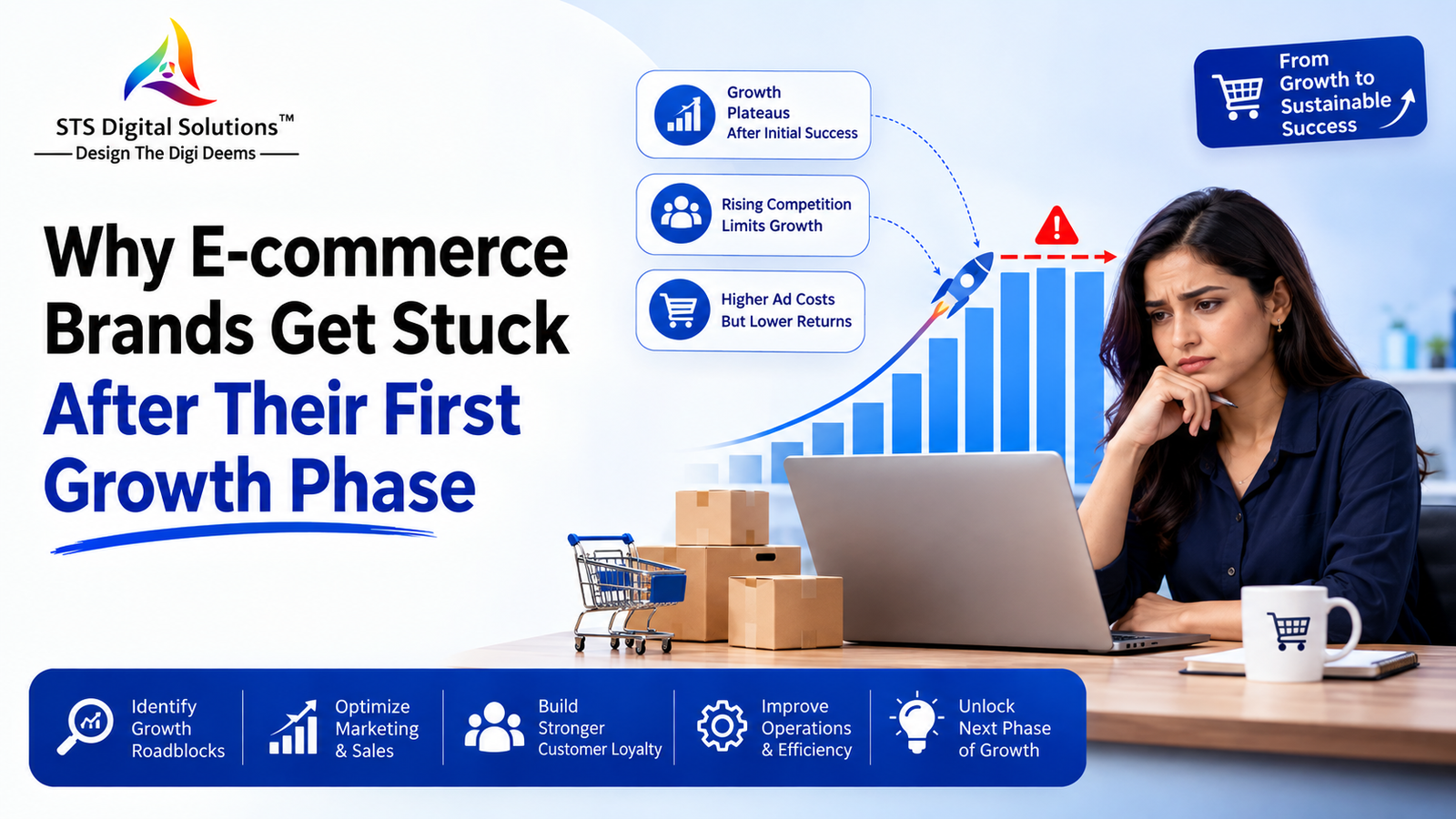
A new online shop opens up with a good product, a relatively small group of customers who are really into it, and a marketing strategy that works right from the start. Sales begin to happen.
Marketing efforts are amplified. Sales go up again. More products are added. New people are hired. The business grows. But things have changed.
Money keeps on moving, just not at the same rate. Marketing gets more costly. Customers stop coming back as frequently as expected. Inventory gets more difficult to handle. Conversion rates are unstable. The founder of the business begins to ask a question that gets quite annoying after a while: “Why is it becoming so hard to grow?” This is a typical evolution of e-commerce businesses.
The early success of some e-commerce businesses might be due to a great product, a well-served niche market, word-of-mouth marketing, or a successful ad campaign. However, achieving further success requires more discipline.
E-commerce growth challenges that arise after the initial success of such businesses are usually not caused by any single issue. They happen simply because the processes supporting a small business weren’t meant to operate at a larger scale.
Industry Insights
Growth of e-commerce has become a challenging process due to increased choice for customers and competition among businesses operating in an ever-crowded online space.
A customer might come to know about a particular brand through social media, compare it with the competition using a search engine, look up reviews, compare prices in different marketplaces, wait for a promotion before finally making the purchase.
Attention-grabbing is just the start.
As a brand grows, it will increasingly be under the pressure of maintaining margins despite increased investments in attracting new customers. What works as an effective campaign on a smaller scale may not be as effective when the audience becomes oversaturated.
Operations will also become more complex.
Increased orders might require increased stock management, customer service, return orders, fulfillment, and shipping. In other words, a business might see revenue growth without having seen comparable operations or financial growth.
This is the reason why e-commerce growth challenges have to be treated as a mixture of marketing, customer, financial, technological, and operational challenges.
Expert Commentary
The most important shift after early success is moving from opportunistic growth to a repeatable growth system.
A brand that has found product-market fit should not assume that increasing advertising expenditure is the natural next step.
Before scaling, businesses need to understand the economics behind existing growth.
Know What a Customer Is Actually Worth
Customer acquisition cost becomes increasingly important as advertising budgets grow.
If a business spends heavily to acquire customers who make only one low-margin purchase, increasing the acquisition budget can make the problem worse.
Brands should evaluate acquisition cost alongside average order value, gross margin, repeat purchase behaviour, and customer lifetime value.
The objective is not necessarily to acquire the cheapest customer. It is to acquire customers whose long-term value justifies the investment.
Growth Should Not Depend on One Channel
Many young e-commerce businesses discover one channel that works and then become dependent on it.
That channel could be paid social advertising, search advertising, marketplaces, influencer marketing, or organic search.
Dependence creates risk.
Changes in platform algorithms, advertising costs, competition,n or customer behaviour can significantly affect performance. A more resilient business develops multiple acquisition and retention channels over time.
Retention Becomes More Important as Acquisition Gets Harder
Early-stage brands often focus heavily on acquiring new customers.
As the business matures, retention becomes increasingly important.
A customer who already trusts a brand generally requires less education than someone discovering it for the first time. Email marketing, personalised offers, loyalty programmes, useful content and strong post-purchase experiences can support repeat purchasing.
The exact retention strategy depends on the product category and buying frequency, but the principle remains consistent: growth should not depend entirely on constantly finding new customers.
Proof & Real-World Perspective
Consider an online skincare company that grows rapidly through paid advertising.
Its first campaign performs exceptionally well because the product is new to the target audience. The brand reinvests the revenue into more advertising and expands its campaigns.
Eventually, performance begins to decline.
The audience has become more familiar with the brand. Competitors are bidding for the same customers. Advertising costs increase, while conversion rates fall.
The company could respond by simply spending more.
But a stronger response might involve improving retention, introducing complementary products, building an email database, creating educational content, and strengthening organic search visibility.
The same principle applies to an apparel brand.
If sales increase but returns also rise because customers struggle with sizing information, the business may technically be growing while losing efficiency.
Improving product descriptions, size guidance,, and customer communication could create more value than simply increasing traffic.
These examples illustrate an important reality: revenue growth can conceal structural weaknesses.
Analysis
Several ecommerce growth challenges tend to appear repeatedly as brands move beyond their first stage of success.
Rising Customer Acquisition Costs
As more businesses compete for the same audiences, acquiring new customers can become more expensive.
Brands need stronger differentiation, better creative, improved targeting, and a broader channel strategy rather than relying solely on increasing bids or budgets.
Conversion Problems
More visitors do not automatically create more revenue.
A brand may have strong traffic but weak product pages, unclear messaging, complicated checkout processes or insufficient trust signals.
Improving the conversion journey can sometimes create more value than acquiring additional visitors.
Customer Retention Gaps
A business that constantly replaces lost customers with new ones can create the appearance of growth while operating an inefficient acquisition machine.
Retention should therefore be measured alongside acquisition.
Operational Complexity
Scaling an online store can expose weaknesses in inventory management, fulfilment, customer service and returns.
The processes that work for 100 orders may become inefficient at 1,000.
Technology and operational systems need to evolve with the business.
Margin Pressure
Revenue is not the same as profitability.
Discounting, advertising expenses, payment fees, returns, shipping costs and fulfilment expenses can significantly affect the actual contribution from each order.
Brands should understand unit economics before deciding how aggressively to scale.
Technology Limitations
An e-commerce platform may work perfectly during the early stage but become restrictive as product ranges, traffic, integrations or operational requirements increase.
Poorly connected systems can create data gaps and manual processes that slow the organisation down.
Recommendations
Businesses facing ecommerce growth challenges should resist the temptation to solve every problem simultaneously.
Instead, establish where growth is currently breaking down.
Audit the Customer Acquisition Funnel
Review traffic sources, campaign performance, conversion rates and acquisition costs.
Identify which channels generate customers rather than simply clicks.
Analyse Customer Retention
Measure repeat purchase rates, time between purchases and customer lifetime value.
Look for opportunities to increase the value of existing customers through relevant products, better post-purchase communication and improved customer experiences.
Improve Conversion Before Increasing Traffic
Review product pages, checkout processes, mobile usability, trust signals, shipping information and calls to action.
If existing traffic is not converting efficiently, additional traffic may simply increase the cost of an inefficient funnel.
Strengthen Organic Visibility
Paid advertising can accelerate growth, but sustainable e-commerce businesses benefit from organic discovery as well.
SEO-driven category pages, product content, useful guides and informational resources can create long-term acquisition opportunities.
Diversify Acquisition Channels
Avoid building the entire business around one platform.
A combination of SEO, paid search, social media, email marketing, content and other relevant channels can create greater resilience.
Track Unit Economics
Know the economics behind each transaction.
Monitor acquisition cost, margins, average order value, return rates and customer lifetime value before aggressively increasing marketing expenditure.
Build Systems Before They Become Necessary
Automation, analytics, inventory management, customer support systems and integrations should evolve before operational complexity becomes a bottleneck.
The objective is to create infrastructure that supports growth rather than constantly reacting to problems caused by it.
Closing Thoughts
The first stage of e-commerce growth can be exciting because almost every improvement produces visible results. The second stage is different. The business must prove that its growth model can remain efficient when acquisition becomes harder, competition increases and operations become more complicated.
Understanding ecommerce growth challenges is therefore not about identifying everything that could go wrong. It is about recognising the transition from selling successfully to scaling systematically.
Brands that understand their unit economics, retain customers, diversify acquisition, improve conversion and strengthen their operational foundations are better positioned to grow without sacrificing profitability.
STS Digital Solutions can support e-commerce businesses with digital marketing, SEO, paid advertising, website development, and other digital growth services designed around measurable business objectives. When technology, marketing and customer strategy work together, the next phase of growth becomes less about chasing volume and more about building a stronger, more sustainable e-commerce business.

Sahil Goyal
Founder & CEO – STS Digital Solutions
Sahil Goyal is an experienced digital marketing strategist and growth leader, who has assisted some of the most successful BFSI & Healthcare, Automotive, and E-Commerce brands to attain sustainable and quantifiable digital success. Being the Founder & CEO of STS Digital Solutions, he spearheads performance-oriented actions in SEO, Digital Marketing, Social Media Marketing, Performance Marketing, E-Commerce Marketing, which assist business to create substantial online presence and generate continuous growth in revenues.
He is a pragmatic and data-driven consultant that focuses on the development of the scalable digital strategies wherein technical SEO, high-quality content, paid advertising, and performance marketing are merged. He is of the opinion that marketing should be aligned with the obvious business objectives, such as more organic traffic, stronger social media brand awareness, paid campaigns that are more ROI-friendly, or more e-commerce brands conversions.
Maximize Your Online Impact - Contact Our Experts!