


Why Mobile App Development is a Competitive Advantage in 2027
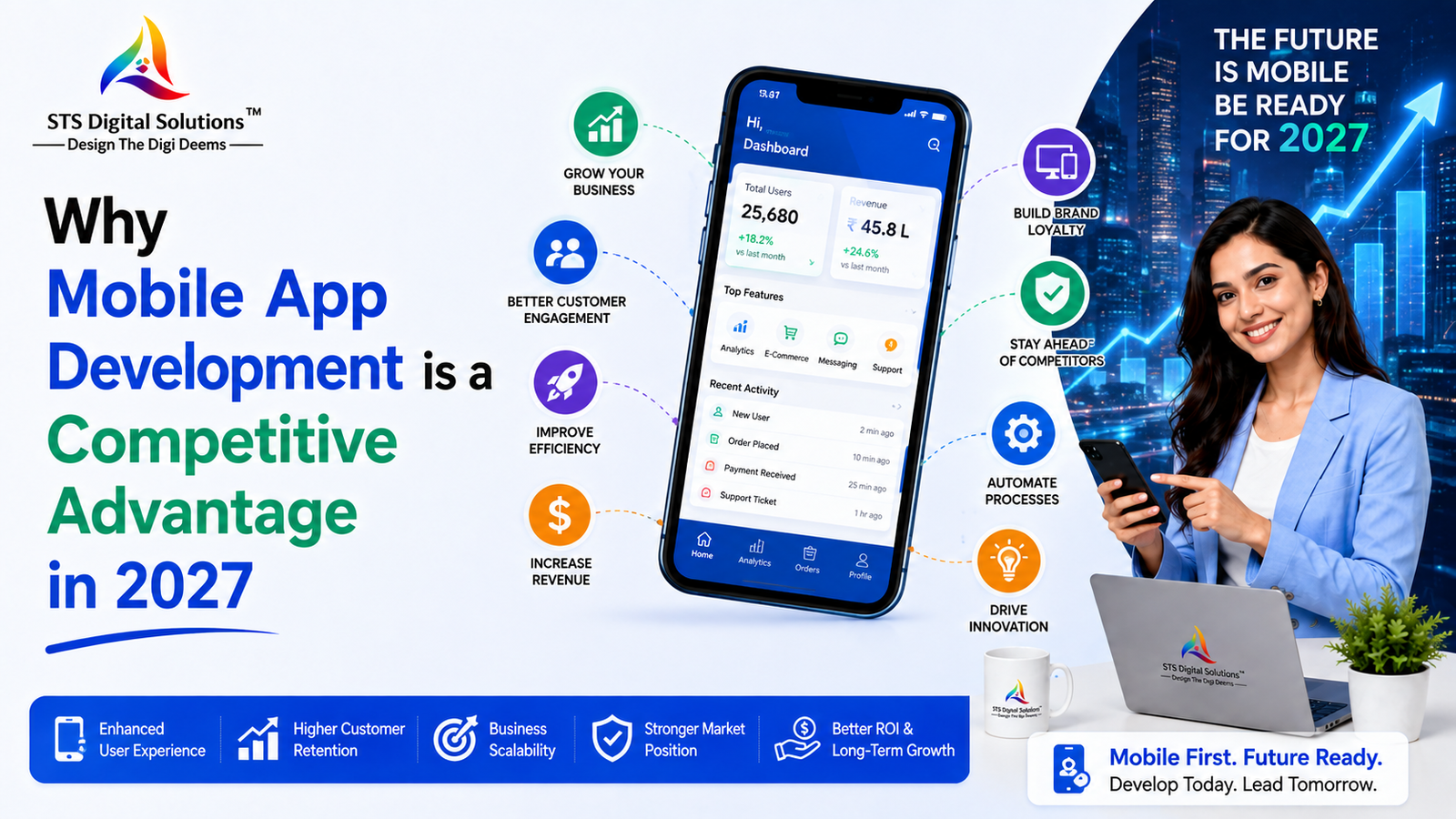
Think of a customer ordering from a business when traveling. There are two possibilities for this customer. One organization sends him through an intricate process of finding his goods via a complicated website where he needs to fill out his information and navigate through multiple web pages. The other organization allows him to open an app and place an order in several minutes, getting up-to-date information on it right after placing.
The products can be identical. Even the prices can be similar. But still, the second company will seem much easier, faster, and more convenient.
This kind of differentiation becomes more and more important in 2027.
Nowadays, customers compare organizations not just by products and price. They also compare organizations by the effort that it takes them to integrate a certain brand into their daily routine. For most organizations,s mobile app development has thus transformed from a technology solution into a customer convenience tool and internal efficiency booster.
The competitive advantage lies not in having an app, but in doing things better than competitors through the app.
Industry Insight
The use of mobile apps has transformed greatly in recent times, with the growing confidence of consumers using their smartphones to handle everyday activities. It is now possible to make purchases, do banking, order food, arrange transport, book hospital appointments, get an education, entertain oneself, or access professional services using a mobile device.
Customer expectations have therefore transformed as well.
Customers are increasingly expecting their interactions with companies to be fast, personal, and available at any point in time. Failing to do this and forcing the customer to go through unnecessary processes, such as repetition, will simply mean the loss of business to a competitor.
Meanwhile, businesses want to explore ways to automate repetitive tasks and analyze consumer behavior. Contemporary apps can interact with payment systems, CRM systems, inventory management systems, analytics platforms, cloud computing systems, and AI.
It has thus become relevant to develop mobile apps in the context of both customer-facing and business operations.
An e-commerce company may use an app to increase repeat purchases. A healthcare provider may use one for appointments and patient communication. A logistics company can provide delivery tracking, while a field-service organisation can allow employees to access records and update job information remotely.
The opportunity is not limited to large enterprises. Small and mid-sized businesses can also use focused applications to differentiate their services when the technology directly supports a genuine customer or operational need.
Expert Commentary
The most important principle for businesses considering an app is simple: start with the problem, not the technology.
Many companies make the mistake of asking what features their application should contain before understanding what users actually need. This can lead to expensive applications filled with functions that customers rarely use.
A stronger approach begins by studying the customer journey.
Where do customers experience friction? What information do they repeatedly request? Which process takes too long? Where do employees perform repetitive manual work? Which part of the existing digital experience causes users to abandon the journey?
These questions help identify where an application can create measurable value.
User Experience Should Come Before Feature Count
A successful application does not necessarily have dozens of features. It needs the right features arranged around the user's priorities.
For example, a restaurant application may not need an extensive social network, gaming features, or unnecessary menus. Customers may simply want fast ordering, secure payment, delivery tracking, and easy reordering.
Removing friction can be more valuable than adding complexity.
Integration Is a Strategic Requirement
Businesses should also consider how the app will interact with existing systems.
An application that cannot communicate with inventory, CRM, payment, customer support, or analytics systems may create another disconnected workflow.
Well-planned integration can allow information to move between platforms more efficiently and provide businesses with a more complete view of their customers and operations.
Security cannot be an Afterthought.
Mobile applications can handle sensitive information, including personal details, payment information, account credentials, and business data.
Security should therefore be considered during architecture and development rather than added at the end. Secure authentication, appropriate data handling, regular updates, and ongoing monitoring are important parts of responsible app management.
Proof & Real-World Perspective
Consider a retail business that receives a large percentage of repeat orders from existing customers.
If every repeat purchase requires the customer to search the website, enter details, and navigate the same process again, there is unnecessary friction. An application could simplify the journey through saved preferences, previous orders, personalised recommendations, and faster checkout.
The advantage is not simply that the company has an app. The advantage is that the app makes repeat purchasing easier.
A similar principle applies to service businesses.
Suppose a maintenance company has technicians working at multiple customer locations. Employees may previously have depended on phone calls, spreadsheets, or paper-based records to access job information. A business application could give technicians access to customer details, service history, schedule,s and job updates from the field.
The result can be improved coordination and less administrative work.
These examples demonstrate an important point: the value of an application should be measured by the business outcome it creates.
Downloads alone do not prove success.
Active users, retention, conversion, customer satisfaction, repeat transactions, reduced processing time, and operational efficiency can provide much more meaningful evidence.
Analysis
The competitive value of mobile app development comes from several advantages working together.
Direct Customer Connection
An application can create a direct digital channel between a company and its customers. Instead of relying entirely on search engines, social platforms, or email, businesses can build an environment where customers regularly interact with the brand.
Personalised Experiences
Applications can support personalised content, recommendations, and communication based on relevant user behaviour and preferences.
When personalisation is genuinely useful, it can make the experience feel more relevant and reduce the effort customers need to find what they want.
Improved Operational Efficiency
Applications are not only customer tools. Internal business applications can help employees manage workflows, access information, and update records from anywhere.
For businesses with distributed teams, sales representatives, technicians, or delivery personnel, this can be particularly valuable.
Better Business Intelligence
Digital interactions can provide valuable insights into how users navigate an application, which services they use, and where they encounter difficulties.
Businesses can use these insights to improve products, customer journeys, and marketing strategies.
Stronger Differentiation
When competitors offer similar products, experience can become a major differentiator.
A fast, intuitive, and useful application can give customers a practical reason to choose one business over another.
However, there are risks. Poor performance, confusing navigation, excessive notifications, inadequate security, and infrequent updates can damage customer trust instead of creating a competitive advantage.
This is why an application should be treated as an evolving digital product rather than a one-time development project.
Recommendations
Businesses planning mobile app development in 2027 should begin with a clear strategic framework.
Define the Business Objective
Determine exactly what the application is expected to improve. It could be customer retention, sales, service delivery, employee productivity, operational efficiency, or customer support.
A clear objective makes development decisions easier.
Understand the Target Users
Research how users currently interact with the business. Identify their frustrations, expectations, and most frequent tasks.
An application should be designed around real behaviour rather than assumptions.
Prioritise the Minimum Valuable Experience
Start with the features that directly support the application's primary purpose. Additional functionality can be introduced after analysing user feedback and performance.
Plan for Scalability
The application should be capable of supporting future users, features, integrations, and business requirements.
Choosing a suitable architecture and development approach at the beginning can prevent expensive technical limitations later.
Integrate Relevant Business Systems
Consider CRM, payment gateways, inventory, analytics, customer support, and other platforms that the app may need to communicate with.
Integration can determine whether the application becomes a useful part of the business ecosystem or another isolated system.
Measure the Right Results
Set measurable indicators before launch. Depending on the business model, these may include active users, retention, conversion rate, average order value, repeat purchases, customer satisfaction, or time saved.
Keep Improving After Launch
Launching the application is only the beginning. User feedback, analytics, technical updates, and changing market expectations should guide continuous improvements.
Closing Thoughts
In 2027, competitive advantage will increasingly depend on how effectively businesses use technology to remove friction and create better experiences.
Mobile app development can help companies establish a direct relationship with customers, simplify transactions, improve operational workflows, personalise experiences, and make important services more accessible. But the strongest results come when an application is built around a clearly defined business problem rather than technology for its own sake.
For businesses evaluating their next digital investment, the right question is not whether competitors have an app. It is whether a well-designed application can help the business serve customers, operate efficiently, or differentiate itself more effectively.
STS Digital Solutions can help businesses turn that objective into a practical digital solution through strategic planning, development,t and technology expertise. The goal is not simply to launch another application, but to create a useful digital product that continues to deliver measurable value as the business grows.

Sahil Goyal
Founder & CEO – STS Digital Solutions
Sahil Goyal is an experienced digital marketing strategist and growth leader, who has assisted some of the most successful BFSI & Healthcare, Automotive, and E-Commerce brands to attain sustainable and quantifiable digital success. Being the Founder & CEO of STS Digital Solutions, he spearheads performance-oriented actions in SEO, Digital Marketing, Social Media Marketing, Performance Marketing, E-Commerce Marketing, which assist business to create substantial online presence and generate continuous growth in revenues.
He is a pragmatic and data-driven consultant that focuses on the development of the scalable digital strategies wherein technical SEO, high-quality content, paid advertising, and performance marketing are merged. He is of the opinion that marketing should be aligned with the obvious business objectives, such as more organic traffic, stronger social media brand awareness, paid campaigns that are more ROI-friendly, or more e-commerce brands conversions.
Maximize Your Online Impact - Contact Our Experts!